LaRayia Gaston

LARAYIA GASTON is a former model, actress, and founder of the nonprofit Lunch On Me, an organization dedicated to feeding organic, healthy food and holistic healing to those experiencing homelessness. She's also a regular public speaker, podcast guest, and activist. She filmed a documentary 43 Days on Skid Row, which shows her time living with LA’s skid row residents and offers up a true picture of what life is really like in one of America’s largest homeless communities. She resides in Los Angeles. For more, visit lunchonme.org.

Author photo © Whitney Otte

Also By Author

LaRayia Gaston: Love Without Reason

LaRayia Gaston is a former model, actress, and the founder of the nonprofit Lunch On Me, an organization dedicated to offering organic, healthy food and holistic healing to those experiencing homelessness. She’s also a regular public speaker, podcast guest, and activist. She filmed a documentary, 43 Days on Skid Row, which shows her time living with LA’s Skid Row residents and offers up a true picture of what life is really like in one of America’s largest homeless communities. In this podcast, Sounds True founder Tami Simon speaks with LaRayia about her new book, Love Without Reason. They discuss the superpower called “love”; why connection and empowerment are central to ending hunger; gratitude as an action, not just an attitude; transforming our “withholding” and scarcity mindsets; seeing humanity “on every corner, in every person”; and more. 

Gratitude Is a Byproduct of Service

Among the lessons I’ve seen people embrace by performing their microgestures is the true meaning of gratitude. Gratitude has become a big idea in certain circles these days, and a lot has been written about research showing that a focus on gratitude has real benefits for people in terms of their mental and physical well-being.3 This is probably why the practice of gratitude journaling has become so popular. You can even buy gratitude journals at your local bookstore ready for you to fill in the blanks about what makes you feel lucky today.

I have to admit that I have a bit of a bone to pick with the gratitude journalers of the world. It’s not that I disagree with the research or the idea that gratitude can be a powerful force. It’s that I think the idea of gratitude, perhaps because it has become so popular, is too often misunderstood.

I don’t believe that gratitude is about sitting in your room and saying thanks so only your walls can hear you. I don’t believe it’s something that should remain in the pages of a journal. I don’t believe it’s something you can find on a bracelet or in an Instagram quote. These can be good ways to remind yourself to be thankful, but they’re not enough. That’s because gratitude isn’t meant to be passive. “God is a verb,” as Paulo Coelho once said in an interview with Oprah Winfrey about his bestselling book, The Alchemist.4 I believe that gratitude, too, needs to be treated as an action.

In fact, we used to talk about gratitude in terms of giving thanks, which makes it sound so much more active, instead of merely being thankful. Rightly so, because I believe gratitude is something you should do, not something you merely think or feel or write about. This means you can’t just read in the news about the hurricane that devastated a town or the drug problem that plagues a community and feel thankful that you’re removed from it and safe. You can’t just walk by people in need and feel sorry for their suffering and grateful that you’re not in the same position. True gratitude is more than just a feeling. It’s the expression of that feeling through action—the action of serving others. To truly be grateful, you have to act gratefully.

It’s a bit like that old philosophical question about whether, if a tree falls in the woods and no one hears it, did it really fall? By the same token, if you love someone but you never express that love, either verbally or through your actions, can you really call it love? If you’re grateful for what you have but never extend that gratitude to others, then are you truly living a grateful life?

When we mindfully show our appreciation for what we have through the action of serving others, then gratitude is the result. It’s the byproduct of that service, and there’s really no other way to get it. We live in a world that loves shortcuts. If there’s a faster, easier, simpler way to get something done, then we’re all over it. People write about “life hacks” as if they’re going to save us, but some things can’t be hacked. I believe that gratitude is one of them.

In the energy exchange, there’s a dynamic between people made up of living, breathing energy that flows back and forth. When that energy stops moving, it dies. Gratitude has an energy behind it too, but I believe that energy dies, or at least atrophies, when we keep it confined to our thoughts and prayers or the pages of our journal. Even sharing grateful thoughts on social media—which I highly encourage as an antidote to all the complaints and judgments that tend to be put on display—is not the same as allowing our gratitude to inspire us to act on behalf of others. Because it’s so often relegated to contexts like these, gratitude is really in danger of losing its meaning.

I was once in a yoga class that was winding down on a hot day when I witnessed a missed opportunity to really live gratitude. We were all sitting in Lotus Position with the lights dimmed and the door open so the breeze could flow through the studio. Soft music was playing in the background and our hands were pressed together at our hearts as we whispered our “namastes.” Just then a man, who appeared to be suffering from mental illness, walked in through the open door to say hello and ask, “What are you all doing in here?” He was friendly

enough, but the reaction was immediate. The people closest to him scattered while others turned away or shook their heads. No one answered him. I meant to, but I didn’t gather my thoughts quickly enough. The teacher rushed over to tell him to leave, pushing him out the door and closing it behind him.

It was as if everyone in the room had forgotten what they’d been doing right before the man walked in. Yoga classes often end with the students saying namaste as an expression of gratitude for the experience they just had, the teacher who guided them through it, and the fellow students they shared it with. But it’s also generally considered to have spiritual connotations, to be a conscious acknowledgment of another person’s soul, of the divine light that resides in all of us. Some literally translate namaste from Sanskrit to mean: “The light in me acknowledges the light in you.”

I guess my fellow classmates decided that not everyone was worthy of a namaste. I don’t mean to be overly harsh. I get why people were frightened, as they often are by mental illness, or turned off by the disruption when they were in the midst of a peaceful moment. But if we’d all taken a moment to simply notice this man (an act of non-resistance), I think it would have quickly become clear that he meant us no harm. He was just curious and, I think, lonely. It seemed like what he wanted most of all was someone to talk to, and here he’d found a group of people expressing gratitude in a tranquil place. We can perhaps forgive him for thinking we were the kind of people who might be receptive to his attempt to connect.

We live in an amazing time. Being part of the Information Age gives us exposure to all kinds of wisdom and ancient teachings along with all the new. Yoga has been practiced for hundreds of years. Verses on gratitude can be found in the Bible. There is truth and power in these old ways, but let’s make sure we’re getting the most out of them. These ancient concepts should be more than just things you think to yourself or utter on autopilot. If we really want the benefits, we need to learn how to live them.

If you are grateful for something in your life, you have to find a way to put some of that grateful energy back into the world instead of holding onto it. That’s the only way to keep it flowing. That’s the only way gratitude can come back to you. If you have your antenna up while you perform your microgestures, you’ll start to notice the flow and you’ll start to better appreciate when some of it flows back your way.

❤ HEARTWORK ❤

Ask yourself: How can I do more than just think grateful thoughts? How can I act gratefully in the world today?

If you keep a gratitude journal, consider recording not just what you’re thankful for, but the full energy exchange: what you’re grateful for and what you gave gratefully in return.

Notes:

  1. Colby Itkowitz, “The Science Behind Why You Shouldn’t Stop Giving Thanks After Thanksgiving,” The Washington Post (November 24, 2016).
  2. Paulo Coelho, “What if the Universe Conspired in Your Favor?” Oprah’s SuperSoul Conversations (August 9, 2017). 

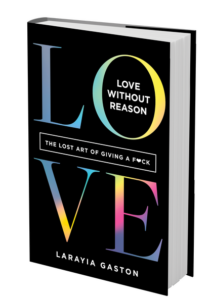
This is an excerpt from Love Without Reason: The Lost Art of Giving a F*ck by LaRayia Gaston.


larayia gaston author photoLARAYIA GASTON is a former model, actress, and founder of the nonprofit Lunch On Me, an organization dedicated to bringing organic, healthy food and holistic healing to those experiencing homelessness. She’s also a regular public speaker, podcast guest, and activist. She resides in Los Angeles. For more, visit lunchonme.org.


love book coverSounds True | Amazon | Barnes & Noble | Indiebound | Bookshop

You Might Also Enjoy

David Whyte on Being at the Frontier of Your Identity

There is a particular kind of tiredness that comes from trying to hold a fixed idea of who we are, year after year, as everything around us keeps changing anyway. David Whyte built an entire body of work around that tension, and Sounds True founder Tami Simon has called her conversation with him one of the most beloved episodes in Insights at the Edge history, still resonating with new listeners more than a decade after it first aired. Something about the way Whyte speaks, unhurried and image-rich, seems to reach people in exactly the season of life where old answers have quietly stopped working.

Sounds True has carried David Whyte’s poetry, prose, and audio programs for years because few voices manage to speak so plainly to both the individual soul and the modern workplace at once. His willingness to bring genuine poetry into rooms built for spreadsheets and quarterly targets reflects the same spirit our founder set out to preserve back in 1985: teaching captured in its own unscripted, living voice. 

What follows traces the frontier Whyte describes between who we were and who we are becoming, how exile trains us for that edge, and why a Yorkshire poet ended up teaching creativity inside boardrooms at Boeing and American Express.

Key Takeaways:

  • Originality Has an Address: Learn why David Whyte locates creativity at the frontier of identity, not behind it.
  • Exile Is a Skill: Understand why Whyte treats feeling like an outsider as something to develop, not escape.
  • Poetry Enters the Boardroom: See how poetry and leadership intersect in Whyte’s decades of corporate work.

Learn Practices for Self-Compassion with Sounds True.

Originality Lives at the Edge, Not the Center

Whyte traces originality back to what he calls an edge identity, a frontier conversation that shows up across many of the world’s wisdom traditions. Reality itself, in his framing, is conversational rather than fixed, which means the self is never a finished project so much as an ongoing exchange with everything it meets. 

Sounds True’s founder has described sitting with fourteen pages of notes on his teaching and underlining nearly every line, a reaction that says something about how differently Whyte approaches familiar questions of purpose and change, treating originality as a place a person stands rather than a trait they possess. 

You can hear the full exchange in David Whyte on Being at the Frontier of Your Identity, still one of the most requested episodes in the archive.

Exile as a Core Human Competency

Rather than treating exile, the felt sense of not quite belonging, as a wound to heal, Whyte reframes it as a competency worth developing on purpose. Most people spend enormous energy trying to eliminate the feeling of being an outsider, whereas Whyte suggests the more useful move is to learn to work with it deliberately. A few ideas anchor this reframing:

  • Exile Sharpens Perception: Standing slightly outside a group often reveals what belonging obscures.
  • Competency, Not Condition: Whyte treats exile as a trainable skill rather than permanent exclusion.
  • Frontier Over Center: Growth tends to happen at edges, not in comfortable middles.

This distinction matters because it removes the shame often attached to feeling like an outsider. Instead of a problem to solve, exile becomes a vantage point worth returning to on purpose.

The Frontier of Identity as a Living Threshold

The frontier of identity, Whyte’s central image, is not a line crossed once and left behind. It is a threshold a person returns to repeatedly, every time old certainties no longer fit a new season of life. Whyte suggests that vulnerability, often treated as weakness, actually functions here as enhanced perception, a heightened sensitivity that lets a person notice what a settled identity tends to miss.

He describes reality itself as conversational, meaning the self is shaped less by fixed traits and more by an ongoing exchange with circumstances, relationships, and unexpected turns. Standing at this frontier repeatedly, rather than resolving it once, is what Whyte considers the actual work of a lived, honest life.

Insight Is The First Step Toward Growth. Broaden Your Horizons With Sounds True.

Poetry and Leadership: An Unlikely Partnership

Long before this conversation, Whyte had already built a second career inside corporate life, consulting for companies including Boeing, Kodak, and American Express. His bestselling book, The Heart Aroused, argued that corporations suffered from too little poetry and too little humanity, a critique that landed him on business bestseller lists rather than only poetry shelves. This pairing of poetry and leadership runs through nearly everything Whyte has written since, treating verse not as decoration for executives but as a discipline for genuine reflection.

Whyte has predicted that the very word manager will eventually give way to something more alive with possibility, a shift he sees poetry as uniquely equipped to prepare leaders for. Rather than offering leadership frameworks or checklists, his workshops use verse to slow a room down enough to notice what usual business language tends to skip over entirely.

  • Work as Pilgrimage: Whyte frames a career less as a task list and more as a journey of identity.
  • Burnout Reconsidered: He suggests exhaustion can signal a need for renewal, not simple failure.
  • Conversational Leadership: Genuine leadership, in his view, requires ongoing dialogue, not fixed authority.

Tapping the Invisible Support That Surrounds Us

Whyte closes much of his teaching on a note of quiet reassurance: that unseen support often surrounds a person exactly when they feel most exposed at the frontier of their own becoming. Recognizing this support, rather than assuming isolation, changes how a person approaches uncertainty, whether it shows up as a career change, a creative block, or a simple shift in how someone sees themselves.

Where Poetry Meets Everyday Attention

Whyte often describes a good poem as revelatory, something that takes hold of a reader and surprises them into new understanding rather than confirming what they already believed. This distinction matters for how he teaches: poetry, in his hands, is not a retreat from ordinary life but a way of paying closer attention to it. A single well-chosen image, he suggests, can reorganize how someone relates to a problem that logic alone has failed to move.

Awaken Your Inner Healing Power

Final Thoughts

David Whyte’s teaching never promises a finished self waiting somewhere ahead. It offers something steadier: the frontier itself as home ground, revisited again and again across a lifetime of work and relationship. What makes this conversation endure, more than a decade after it first aired, may be exactly that refusal to offer a tidy arrival point. 

Sounds True keeps returning to this conversation because it captures exactly what our mission asks of us, waking up to the edges we usually try to avoid rather than the comfortable center we think we want.

If Whyte’s words found you today, his fuller catalog of poetry and prose is waiting to keep the conversation going, one frontier at a time.

Frequently Asked Questions About David Whyte

Who is David Whyte?

He is a Yorkshire-born poet, author, and Fortune 500 consultant known for blending poetry with leadership.

What Sounds True programs feature David Whyte?

Sounds True has released Clear Mind, Wild Heart and What to Remember When Waking with David Whyte.

Does David Whyte only write poetry?

No, he has also authored prose books, including Crossing the Unknown Sea and The Heart Aroused.

What companies has Whyte worked with as a consultant?

He has led workshops at Boeing, Kodak, American Express, and Bristol-Myers Squibb, among others.

What podcast features this conversation with Whyte?

It appears on Insights at the Edge, hosted by Sounds True founder Tami Simon.

Is this conversation relevant outside creative fields?

Yes, Whyte’s ideas on identity and leadership apply broadly across careers, relationships, and life stages.

Where can I explore more spiritual teachers like David Whyte?

Visit our All Teachers & Authors page to browse voices across many traditions and disciplines.

Does Sounds True offer related content on purpose and vocation?

Yes, related titles appear throughout our Conscious Business and Spirituality & Awakening collections.

Michelle Cassandra Johnson is an author, activist, spiritual teacher, racial equity consultant, and intuitive healer. She is the author of six books, including Skill in Action and Finding Refuge. Amy Burtaine is a leadership coach and racial equity trainer. With Robin DiAngelo, she is the coauthor of The Facilitator's Guide for White Affinity Groups. For more, visit https://www.michellecjohnson.com/wisdom-of-the-hive.

James Hollis: Underneath the Midlife Crisis

Midlife can bring questions about identity, purpose, and the direction our lives have taken. James Hollis offers a thoughtful perspective on what these questions may reveal about our inner lives.

At Sounds True, spiritual wisdom and transformational teachings have been shared since 1985, creating a living library that supports mindfulness, self-reflection, and personal growth.

In this piece, we will discuss James Hollis, what lies underneath the midlife crisis, and the deeper questions that can emerge in the second half of life.

Key Takeaways:

  • Midlife Perspective: James Hollis approaches midlife through a Jungian lens, bringing attention to the psychological questions that can emerge during major transitions.
  • Inner Awareness: The conversation considers how fear, unconscious patterns, and self-reflection can deepen our understanding of the lives we have created.
  • Ongoing Growth: Hollis presents the second half of life as a period in which questions of meaning, identity, and personal development can continue to unfold.

Find Teachings that Speak to You With Sounds True.

James Hollis on the Meaning of a Midlife Crisis

For James Hollis, midlife can bring our established identity into question. Much of who we become is influenced by family, culture, relationships, and the expectations we encounter along the way.

These adaptations can help us find our place in the world, but they may not fully express who we are. In James Hollis: Underneath the Midlife Crisis, Hollis considers what happens when the life we have created begins to feel out of alignment with our deeper inner experience.

Underneath the Midlife Crisis: What Is Really Happening?

Looking underneath the midlife crisis means paying attention to the questions beneath our discomfort. Rather than viewing uncertainty only as a problem to overcome, Hollis’s perspective encourages us to consider what it may be asking of us.

Fear can become part of this inquiry. Moving forward may require us to recognize fear while remaining open to choices that reflect a deeper sense of self.

Why the Second Half of Life Can Feel Unsettling

The second half of life may challenge assumptions that once gave us direction. Accomplishments, responsibilities, and familiar identities can remain meaningful while questions about purpose and authenticity become harder to ignore.

This shift can ask us to examine how much of our lives has been shaped by external expectations and what we genuinely value now.

Underneath the Midlife Crisis: Questioning the Life We Have Built

Midlife can raise difficult but meaningful questions. Which choices reflect who we have become? Which were shaped by expectations, obligations, or the need to adapt?

Hollis encourages a deeper relationship with these questions. Instead of expecting immediate answers, we can pay closer attention to what repeatedly calls for our awareness and what may have been neglected along the way.

Center Yourself With Meditative Teachings by Sounds True

James Hollis on Finding Meaning in the Second Half of Life

For James Hollis, finding meaning in the second half of life involves looking beyond external measures of achievement. His Jungian perspective turns attention inward, toward the inner life and the parts of ourselves that may not have had room for expression.

This process can help us reconsider what gives our lives meaning and where our energy is asking to be directed.

Embracing Change in the Second Half of Life

Entering the second half of life does not mean having every question resolved. It can instead become an invitation to live with greater awareness of the choices we make and the values guiding them.

Hollis’s reflections encourage us to remain attentive to the deeper questions that emerge through change. By listening to those questions, we can approach this stage of life as an ongoing relationship with meaning, identity, and the person we are still becoming.

Insight Is The First Step Toward Growth. Broaden Your Horizons With Sounds True.

Final Thoughts

James Hollis invites us to see midlife as a time for deeper reflection. By listening closely to the questions beneath uncertainty, the second half of life can become an opportunity to reconsider what matters, reconnect with our inner lives, and move toward a more meaningful way of being.

Frequently Asked Questions About James Hollis: Underneath the Midlife Crisis

Who is James Hollis?

James Hollis is a Jungian analyst, author, and teacher whose work focuses on psychological development, meaning, and the inner questions people encounter throughout adulthood.

What is James Hollis’s background in Jungian psychology?

Hollis trained as a Jungian analyst and has spent decades examining ideas associated with depth psychology. His work often considers how unconscious patterns influence identity, relationships, choices, and personal development.

What does James Hollis mean by the psyche?

In Hollis’s Jungian framework, the psyche refers to the broader inner life, including conscious and unconscious dimensions of experience. Paying attention to the psyche can reveal concerns that our everyday awareness may overlook.

How does Jungian psychology approach major life transitions?

Jungian psychology can view major transitions as periods when unconscious needs, conflicts, and questions become more visible. These moments may prompt deeper examination of identity and personal meaning.

What role does the unconscious play in James Hollis’s teachings?

Hollis gives significant attention to unconscious influences on our lives. His work encourages people to notice recurring patterns, emotions, dreams, and reactions that may point toward concerns outside ordinary conscious awareness.

Why does James Hollis emphasize asking questions?

For Hollis, meaningful questions can help people examine assumptions and patterns that have shaped their lives. The purpose is not always to reach a quick answer, but to develop a more conscious relationship with what is happening internally.

Does James Hollis believe personal growth ends at a certain age?

Hollis’s work presents psychological development as an ongoing process. Later adulthood can continue to bring opportunities for reflection, learning, and a deeper understanding of oneself.

How are relationships connected to James Hollis’s work?

Relationships can reveal personal expectations, projections, and emotional patterns. Hollis’s Jungian perspective encourages examining these patterns rather than assuming another person is solely responsible for fulfilling our psychological needs.

What can listeners expect from James Hollis’s conversation with Tami Simon?

The conversation centers on Hollis’s perspective on psychological development, fear, identity, and the deeper questions that can arise during midlife and beyond.

Who may find James Hollis’s teachings helpful?

His teachings may resonate with people interested in Jungian psychology, personal growth, spirituality, self-reflection, and the psychological dimensions of major life transitions.

Michelle Cassandra Johnson is an author, activist, spiritual teacher, racial equity consultant, and intuitive healer. She is the author of six books, including Skill in Action and Finding Refuge. Amy Burtaine is a leadership coach and racial equity trainer. With Robin DiAngelo, she is the coauthor of The Facilitator's Guide for White Affinity Groups. For more, visit https://www.michellecjohnson.com/wisdom-of-the-hive.

James Hollis: The Goal of Life Is Meaning, Not Happine...

Most of us were raised to chase happiness as the finish line, yet Jungian analyst James Hollis has spent his career arguing that happiness was never a reliable measure to begin with.

Sounds True has carried this conversation between depth psychology and everyday struggle for decades, and Hollis remains one of our clearest voices on the subject. 

In this piece, we look at why Jungian psychology treats happiness as an unreliable goal, how the soul signals when we’ve drifted off course, and what resilience looks like without the comfort of certainty.

Key Takeaways:

  • A Different Measure: Learn why James Hollis treats happiness as an unreliable goal to build a life around.
  • The Soul Sends Signals: Understand how restlessness and dread can point toward a wrong turn.
  • Resilience Without Certainty: See how meaning sustains people through periods without clear answers.

A Different Measure for a Well-Lived Life

Hollis tells Tami Simon that happiness is only ever transiently possible, while meaning, once found, tends to abide. This is not a small semantic distinction; it reorganizes how a person might evaluate an entire life, past and future.

Listen to this conversation in James Hollis: The Goal of Life Is Meaning, Not Happiness, part of the Insights at the Edge series.

Learn Practices for Self-Compassion with Sounds True.

Jungian Psychology’s Case Against Chasing Happiness

Drawing on Jungian psychology, Hollis explains why treating happiness as life’s organizing goal sets people up for repeated disappointment. Moods shift, circumstances change, and pleasure fades on its own schedule regardless of effort. Meaning operates differently in his framework, built less on favorable conditions and more on alignment between a person’s actions and their deeper psychological truth. This idea traces back through decades of depth psychology, which has long treated symptom and suffering as data rather than simply obstacles to remove. Hollis extends that lineage into plain, accessible language for readers outside clinical settings.

  • Happiness Is Transient: It depends on circumstances that are largely outside our control.
  • Meaning Is Durable: It persists even through hardship, loss, and difficult seasons.
  • Alignment Over Pleasure: True satisfaction comes from congruence, not from comfort alone.

How the Soul Signals a Wrong Turn

Hollis describes a kind of inner feedback system, subtle but consistent, that lets a person know when they’ve drifted from their own path: a persistent restlessness, a low-grade dread, symptoms that resist easy explanation. Rather than pathologizing these signals, Hollis treats them as intelligent messages worth decoding instead of medicating them away entirely. This reframing runs through much of his later work, including Living Between Worlds, where he writes at length about resilience during periods of upheaval.

He is careful to add that decoding these signals takes patience. The soul rarely communicates in plain language, and learning to translate restlessness into useful insight is itself a skill built slowly, often with the help of therapy, journaling, or sustained reflection over time.

Resilience Without Certainty

Much of this conversation addresses a question many listeners were quietly asking during a period of global instability: how does a person stay steady without pretending to have answers they don’t have? Hollis’s version of resilience does not rely on optimism. It relies on tolerance for ambiguity and a willingness to keep showing up for the questions life keeps asking, even when no clear resolution is in sight and the ground itself keeps shifting underfoot.

  • Repetition Builds Strength: Resilience grows through repeated encounters with difficulty, not avoidance of it.
  • Certainty Can Deceive: It often functions as a defense against anxiety rather than as an accurate perception.
  • Living Between Worlds: The title itself names the space between old certainties and whatever comes next.

Why Meaning Requires Ongoing Attention

Unlike a goal that can be checked off, meaning in Hollis’s framework demands continual renewal. It is less a destination reached once than a practice sustained through the accumulation of honest choices over time, which is part of why his work resists any tidy self-help formula or five-step solution. A person can find meaning in one season of life and still need to relocate it in the next, since circumstances, relationships, and inner priorities continue to shift.

Center Yourself With Meditative Teachings by Sounds True

The Difference Age Makes

Hollis suggests that this pursuit shifts noticeably across a lifetime. What felt meaningful in early adulthood, often tied to achievement or external validation, tends to lose its hold as people age, replaced by quieter, more internally sourced sources of significance. This isn’t decline, in Hollis’s reading, but maturation, a gradual trading of performance for depth. He describes the second half of life as an invitation to finally ask what was being pursued all along and whether it still fits.

A Fifteen-Book Case for Meaning

By the time of this conversation, Hollis had already authored fifteen books exploring meaning, purpose, and depth psychology, including Finding Meaning in the Second Half of Life and What Matters Most. Hollis describes the search for meaning as the defining topic of his life’s work, one he approaches not as an academic exercise but as something he watches play out daily in his clinical practice with real people navigating real crises, decade after decade, with remarkably consistent patterns.

The Weight of a Global Moment

This particular episode was recorded during a period of widespread uncertainty, and Hollis addresses that context directly rather than avoiding it. He suggests that collective instability tends to surface exactly the kind of questions his work has always centered: what actually matters when the usual supports fall away, and what remains standing once distraction is stripped back. Crisis, in his view, has a way of accelerating psychological work that might otherwise take decades to surface on its own.

What Meaning Asks Us to Give Up

Choosing meaning over happiness, Hollis suggests, often means giving up the comfort of a simpler narrative. It is easier to chase pleasure and call it a life well lived than to sit with the harder, slower project of aligning daily choices with something deeper than mood. Hollis doesn’t romanticize this trade-off; he describes it plainly as more demanding, and ultimately more honest, than the alternative most of us default toward without noticing, especially in a culture that constantly rewards comfort over depth.

The Sounds True Foundation and Wider Access

This particular episode also introduces listeners to the Sounds True Foundation, a nonprofit dedicated to making tools like mindfulness and self-compassion available regardless of financial or social circumstance. It’s a fitting companion to Hollis’s message, since meaning, unlike many luxuries, is something every listener deserves genuine access to explore, regardless of where they happen to start from.

Insight Is The First Step Toward Growth. Broaden Your Horizons With Sounds True.

Final Thoughts

James Hollis offers no promise that meaning arrives easily or stays without tending, only that it holds weight happiness alone cannot carry. 

Sounds True continues sharing this conversation because it captures something central to our mission of waking up the world: that a considered life asks more of us than comfort, and gives back more in return. 

Choosing meaning is rarely a single decision; it is a posture practiced again each time comfort tempts us toward the smaller path. Hollis’s broader catalog remains available for anyone ready to keep asking these questions.

Frequently Asked Questions About James Hollis

How many books has James Hollis written?

Hollis is the author of sixteen books, including Finding Meaning in the Second Half of Life.

What is Living Between Worlds about?

It explores personal resilience during periods of significant change, uncertainty, and cultural upheaval.

Was Hollis a university professor?

Yes, he taught Jungian studies at Saybrook University across its San Francisco and Houston programs.

Does Sounds True offer audio versions of Hollis’s teaching?

Yes, Sounds True has produced the audio learning series Through the Dark Wood with Hollis.

What is the Sounds True Foundation?

A nonprofit making transformational tools accessible to at-risk youth, veterans, and underserved communities worldwide.

Is meaning the same as religious belief, according to Hollis?

No, Hollis frames meaning as a psychological and personal experience, independent of any specific faith.

Where did James Hollis train as an analyst?

He trained at the C.G. Jung Institute in Zurich before practicing as a licensed analyst.

Can this teaching help during periods of grief?

Yes, many listeners find Hollis’s framework useful for locating meaning within difficult, uncertain seasons.

Michelle Cassandra Johnson is an author, activist, spiritual teacher, racial equity consultant, and intuitive healer. She is the author of six books, including Skill in Action and Finding Refuge. Amy Burtaine is a leadership coach and racial equity trainer. With Robin DiAngelo, she is the coauthor of The Facilitator's Guide for White Affinity Groups. For more, visit https://www.michellecjohnson.com/wisdom-of-the-hive.