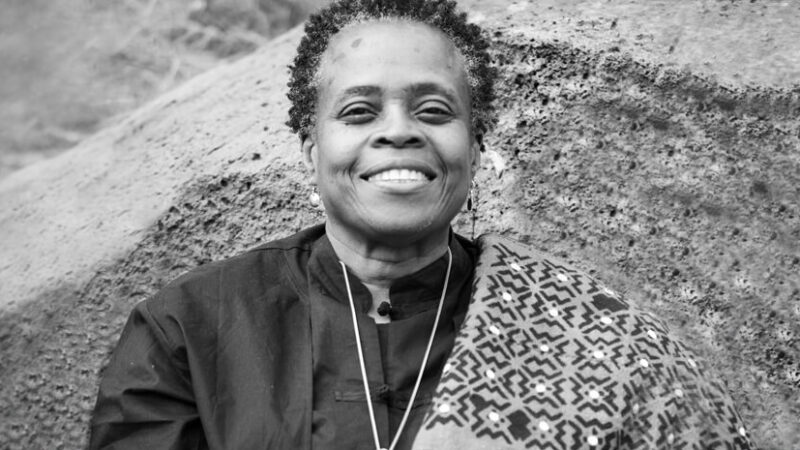
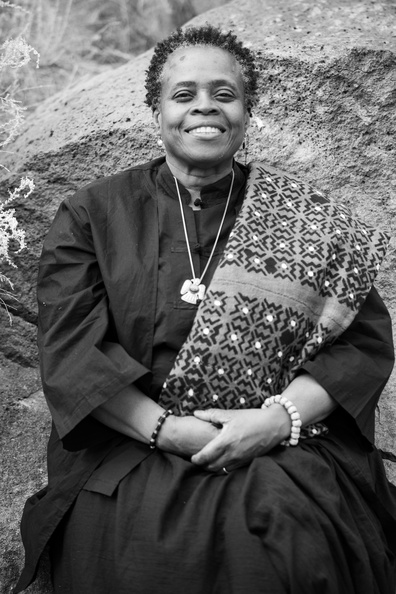
Zenju Earthlyn Manuel

Osho Zenju Earthlyn Manuel, PhD, is an author, poet, ordained Zen Buddhist priest, teacher, and artist, whose diverse background, education, and experience all provide a unique integral and cultural perspective within the space of religion and spirituality. She is the author of The Shamanic Bones of ZenThe Way of TendernessThe Deepest Peace, and more. Manuel is a native of California and now resides in New Mexico. Learn more at zenju.org.

Author photo © Vaschelle André

Also By Author

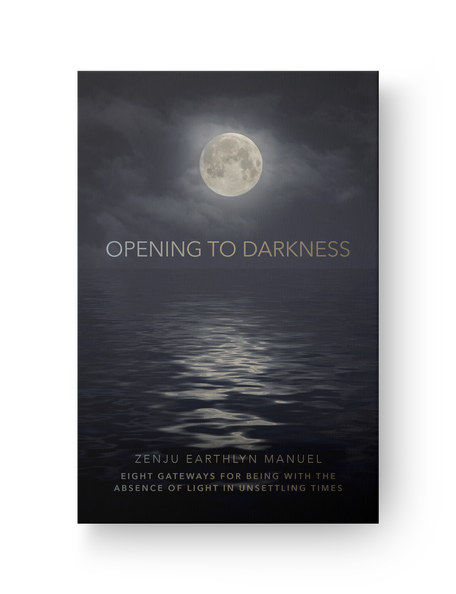
Zenju Earthlyn Manuel: Opening to Darkness

Darkness is an inseparable part of life. Yet instead of resisting it or trying to eradicate it, as society would often have us do, how can we use darkness as fodder for our growth and evolution? In this podcast, Tami Simon speaks with poet, Zen Buddhist priest, and artist Zenju Earthlyn Manuel about her new book, Opening to Darkness: Eight Gateways for Being with the Absence of Light in Unsettling Times, and how we can begin to change the way we relate to darkness and blackness. 

We invite you to turn off the lights and close your eyes (assuming you’re not driving), as you listen to this insightful and provocative conversation exploring “zenju,” or complete tenderness; our longing for light and the call to “enter our caves”; the connection between the bias toward light and the oppression of Black-bodied people; the evolutionary force of blackness; creativity and darkness; the notion of “the absence of light”; the price we pay by avoiding darkness at all costs; how we can’t really know but can only experience light or darkness; the teacher of darkness called death, and the willingness to look at something beyond our control; the inner capacities to stay with darkness; recognizing the spiritual component to darkness; building an intuition and going beyond what is taught and learned about darkness and blackness; being with suffering; silence and darkness; and more.

Note: This episode originally aired on Sounds True One, where these special episodes of Insights at the Edge are available to watch live on video and with exclusive access to Q&As with our guests. Learn more at join.soundstrue.com.

Growing through the Peak of Your Pain

A doctor of Chinese medicine who was a famous bonesetter in China once said to me with a heavy accent, “Here, you [meaning Americans] don’t like to feel pain. You don’t like to suffer.” He said this as he wrung my neck as one would a chicken’s, snapping it back and forth in a way I had never experienced. I screamed as if he were breaking my bones.

For a month prior, I hadn’t been able to move my head to the left or right. My left arm was nearly immobile. I had just started a new job that probably should have ended the moment my body locked up. I went for acupuncture, then pain pills; used ice and hot water bottles. I went to medical doctors, and they X-rayed the area and gave me more pills and a brace to keep my head still—the kind used for whiplash. I later tried one of the best chiropractors in the city, and she gave me the number of a neurosurgeon, thinking I had a herniated disk and would need surgery. I did not seek out the surgeon and stayed in pain for weeks. Finally, a friend from my job gave me the number of her doctor, the famous bonesetter mentioned above. I called him at 10:00 pm that night. That’s how much pain I was in. To my surprise, he answered the phone. He said, “Come in. I wait for you.”

I said, “Now?”

“Yes!” he said. “You have pain, come now.”

Wow, I thought. Now that’s a healer. It didn’t matter that it was the middle of the night.

My partner at the time drove me across the Bay Bridge to San Francisco, and I met my friend from work at the healer’s office. She had come to translate from Mandarin to English. The place was tiny, with photos on the wall of city dignitaries and other famous people who were his clients.

“Hi.” The bonesetter smiled like a boy. “I’m Dr. Fu.”

I sat down in his small room and showed him my X-ray. He threw it on the floor without looking at it. He took the brace off my neck and threw that on the floor, too, right next to the X-ray. Then he twisted me into a pretzel. I howled, yelped, screamed, and hollered.

All of it. No wonder he had me come when no other patients were there. He told me to breathe, and I did my best. Suddenly, at the peak of the pain, I felt my muscles release in my neck, shoulders, and back. It was in fact a miracle to me. I had suffered so long.

I carried my brace and X-ray out in my hands. It was as if I had never been in pain or unable to move. The night sky filled with stars made me feel like I was on another planet. I was in bliss. When I returned to work, everyone was shocked. Was it a miracle, or was it the ability to withstand a greater amount pain to be free of the pain? I would have never imagined that I needed to go deeper into the pain, deeper into the darkness of it. All I had wanted was out.

We are averse to pain and suffering and understandably so, given our American sensibility. We have access to a large market of remedies, products, spiritual paths, and, yes, gateways to the freedom from suffering. I wonder how many times we have diverted our own freedom when we have discovered there is more pain, more trouble, more darkness ahead and we keep adding on remedies. What is the mindset, along with fear and terror, that causes us to avoid our suffering rather than go deeper into seeing what is there? Yes, I should have quit that job on the spot when the pain started, even though I had been there for only a few weeks. I didn’t know at the time, but the pain that was deep inside was because I wanted something different for my life than the job I had accepted. The pain was my impatience, and it was at the same time physical pain in real time. I didn’t wait to allow that“something different” to be revealed in the darkness.

Since all paths—religious, spiritual, or without name—intersect in the place of darkness, darkness is the place where the mind is forced to detach itself from whatever it has grabbed onto in life. And in that nothingness, in that dark place, we awaken.

What of darkness terrorizes us so that we run from it, rather than go deeper into it? How can we bear dark times, or, more explicitly, horrifying times, with the skill of an awakened one? Misery, struggle, and sorrow are not the sole intentions of this life. Yet we can respect our interrelationship with everything in the world, including the suffering in, around, and between us. Is there a way to live in unsettling times that we have forgotten?

Excerpted from Opening to Darkness: Eight Gateways for Being with the Absence of Light in Unsettling Times by Zenju Earthlyn Manuel.

Osho Zenju Earthlyn Manuel, PhD, is an author, poet, ordained Zen Buddhist priest, teacher, and artist, whose diverse background, education, and experience all provide a unique integral and cultural perspective within the space of religion and spirituality. She is the author of The Shamanic Bones of Zen, The Way of Tenderness, The Deepest Peace, and more. Manuel is a native of California and now resides in New Mexico. Learn more at zenju.org.

Through the Fire to Liberated Tenderness

Zenju Earthlyn Manuel is an author and an ordained Zen Buddhist priest whose work and teachings focus upon lived experience in the context of race, sexuality, and gender. Her most recent book, The Way of Tenderness: Awakening through Race, Sexuality, and Gender, discusses how spiritual wisdom divorced from everyday reality is insufficient to heal the wounds of those who have been marginalized. In this episode of Insights at the Edge, Tami Simon and Zenju speak about her experience of racism within dharma practice communities. Zenju also details what she calls “the fiery gateways” that she had to walk through as part of her spiritual journey. Finally, Tami and Zenju talk about what Zenju calls “liberated tenderness.” (79 minutes)

Photo Credit: Vaschelle André of Divine Photography

You Might Also Enjoy

David Brooks: Perception Is an Act of Creation

What does it mean to truly see another person—not just their surface, but their soul, their yearning, their infinite dignity?

This week, Tami speaks with David Brooks—acclaimed New York Times columnist, author, and PBS NewsHour commentator—about his remarkable journey from emotional guardedness to what he calls “heart vision.” In this profound interview on Insights at the Edge, David shares the mystical experiences that transformed his understanding of human connection, including a pivotal moment in a New York subway when he suddenly perceived everyone around him as souls in motion.

Join Tami and David to explore:

  • David’s emotional awakening and the journey from cerebral detachment to human vulnerability
  • The distinction between diminishers and illuminators—and how we see others
  • Why attention is the ultimate form of generosity and morality
  • The difference between heart intelligence and mental intelligence
  • How perception itself is an act of creation, not passive observation
  • Practical skills for seeing others deeply: the on/off switch of attention, being a loud listener, and avoiding the topper trap
  • Why he identifies as a religious rather than a spiritual person
  • The moral order of the universe and how our yearnings reflect something woven into reality itself
  • How rupture and repair shape us—and why staying in pain can be necessary for growth

David’s wisdom reminds us that in a world increasingly dominated by data and algorithms, the art of truly seeing another human being remains our most sacred—and most practical—capacity.

Listen now to discover how cultivating the illuminator’s gaze can transform every relationship in your life.

This conversation offers genuine transmission—not just concepts about awakening, but the palpable presence of realized teachers exploring the growing edge of spiritual understanding together. Originally aired on Sounds True One.

Frank Ostaseki: “I’m Allergic to the Notion of a G...

What truly matters when we face the end of life? After decades of sitting at the bedside of hundreds of dying people, Frank Ostaseski has distilled the deepest human concerns into two essential questions: Am I loved? Have I loved well?

This week on Insights at the Edge, Tami welcomes Frank Ostaseski—co-founder of America’s first Buddhist hospice, the Zen Hospice Project, founder of the Metta Institute, and author of The Five Invitations: Discovering What Death Can Teach Us About Living Fully. Frank brings extraordinary wisdom from his pioneering work in compassionate end-of-life care, along with profound personal insights from his own encounters with heart surgery, strokes, and the transformative vulnerability of being “on the other side of the sheets.”

Join Tami and Frank to explore:

  • The two essential questions that arise when facing death—and what they reveal about living fully now
  • Why emotional flexibility is the true condition for healing and transformation
  • How to meet our own fear and pain without abandoning ourselves or others
  • The practice of “allowing” as a path to both wisdom and compassion
  • What happens in the dying process: surrender, reconstitution, and coming home
  • Why Frank is allergic to the notion of a “good death”
  • The indestructible love that emerges when we keep our hearts open through pain
  • How to practice dying by paying attention to everyday endings

This conversation is for anyone grappling with loss, change, or the fundamental questions of existence—offering not prescriptive answers, but the profound medicine of honest presence and the recognition that our vulnerability itself is one of our most beautiful human qualities.

For more with Frank Ostaseski:

Year to Live Course (Spirit Rock Meditation Center)

Spirit of Service (Upaya Zen Center)

Awareness in Action: The Role of Love (Upaya Zen Center, Frank Ostaseski & Sharon Salzberg)

This conversation offers genuine transmission—not just concepts about awakening, but the palpable presence of realized teachers exploring the growing edge of spiritual understanding together. Originally aired on Sounds True One.

A.H. Almaas and Henry Shukman: “The Many Faces of Aw...

What if awakening isn’t a single destination but an endless unfolding of reality’s many faces? This week on Insights at the Edge, Tami Simon facilitates a groundbreaking conversation between two of the most profound spiritual teachers of our time: A.H. Almaas (Hameed Ali), founder of the Diamond Approach, and Zen teacher Henry Shukman.

In this rare dialogue, these teachers—meeting for the first time—explore how different wisdom traditions point to distinct dimensions of awakened experience. Rather than claiming all paths lead to the same mountaintop, they celebrate the unique territory each tradition reveals: from the “blazing forth” of creative emptiness to experiences where consciousness itself dissolves, from the recognition that each point contains the entire universe to the discovery that everything is made of love.

Join Tami, Hameed, and Henry to discover:

  • Why awakening is an endless process rather than a final arrival
  • The profound difference between thinking and heart-knowing
  • How to navigate the fear that arises at the threshold of ego dissolution 
  • The role of trust, compassion, and basic trust in profound transformation 
  • What happens when individual consciousness completely ceases 
  • Why nothingness and being are inseparable faces of reality 
  • How grief and catastrophic loss can become doorways to awakening 
  • The Zen teaching of uni-locality—experiencing that one point is everything 
  • Why love may be the most fundamental nature of reality itself

This conversation offers genuine transmission—not just concepts about awakening, but the palpable presence of realized teachers exploring the growing edge of spiritual understanding together. Originally aired on Sounds True One

>