Customer Favorites

The traveler of aloneness

A friend who regularly reads my personal blog asked if I would comment on what I saw as the difference between what she described to me as ‘loneliness’ and a related experience she referred to as ‘aloneness.’ Here is an excerpt of what emerged from our conversation…

At times, a very familiar sense of ‘loneliness’ can begin to color your world. You may wonder if it will ever go away, when it will yield to your deep longing for connection, and why all the work on yourself has not yet transformed the despair. The feeling of loneliness is a reminder of separation, and has a way of cutting into the aliveness of immediate experience.

The reality of ‘aloneness’, on the other hand, is translucent, in a way, and vibrantly alive. Despite your connection with others, you are asked to make the journey of the heart alone. No one can experience life for you, love and be loved for you, embrace and feel your tender heart for you, or die for you; likewise, you for them.

The traveler of aloneness is at home in this type of environment—and remains committed to it—knowing that organizing her reality around love will almost always trigger the experience of tender vulnerability and penetrating, transformative sadness. Living in the burning alive field of aloneness is so open, so unknown, and so unbearably touching; it is always uncertain and forever without ground or reference point. It reveals the truth that we can never fully look to the known to tell us who we are or anything certain about the nature of love. For love is of the unknown, infinitely creative, and emerging as a firestorm of grace in the radiant here and now.

Within the mandala of purifying aloneness, we know that at any moment our hearts may break, that we may fall in love in the most surprising way, that old dreams are sure to crumble, that what we thought we ‘knew’ *will* dissolve in front of our eyes, and that we *will* inevitably be asked to meet deep waves of feeling and sensation. As we commit to the very embodied path of the heart, only one thing is certain, really: that *everything* that has yet to be metabolized in our somatic environment will come on display, especially in intimate relationship, as it is seeking wholeness and integration.

There is a part of us that knows that as we open in this way, we will no longer be able to avoid the terror of intimacy, the surety of complete exposure, and the reality of crushing aliveness. We may realize that, without our conscious knowing, we have taken some forgotten vow to turn all the way into the preciousness of this life, willing to enter directly into such achy tenderness, into suffering, into penetrating melancholy, into the darkness, and into naked vulnerability—guided only by the unknown and by a love from beyond. It is not easy to live in such an open and unguarded way, but here we are: We have come here to give our hearts to others and to this world.

Though related, the experience of ‘loneliness’ is usually borne out of a resistance to our present experience—a subtle (or not so subtle) abandonment of feelings of grief, sadness, hurt, vulnerability, and shame. In our early environment, certain feelings were simply unsafe to touch, hold, and express—there was no true home made available for them. Because we are wired to do whatever we must to maintain the critical tie to our caregiving surround, we very intelligently and creatively chose to disembody and split off from these wild movements of fierce grace within. This was a very healthy, short-term strategy for a little boy or girl, yet here we are, several decades later, and burning to know the aliveness and mysteries of lover and beloved in this world.

When we are unable/ unwilling to meet these primordial companions—and are not able to stay with, hold, and metabolize them within our own somatic immediacy—we feel cut off from life, lonely, and disconnected. We yearn and long, at the deepest levels, to meet whatever guests appear in this sacred body, for we intuit that each is a special doorway Home. And we become lonely when we are not able to do so. It is the melting of these wounds and tangles that becomes the essence of the path of re-embodiment and opening the heart. The only way out is through; and the only way through is by love.

It is so bittersweet, really. Being an open-hearted human, who is always and eternally both broken and whole, can feel so fragile. Our old friends sadness, grief, jealousy, hopelessness, and raw vulnerability are so often sent away, out the back door of our hearts, and into a lonely forest. This is sad. Please, don’t go, friends! Stay close! Let us keep the door open to these ones, moment-by-moment crafting a warm home and safe refuge for the entirety of what we are. For in doing so, the path from loneliness to aloneness will become illumined, and we will provide safe passage for love in this world.


aloneness


Miranda Macpherson: The Transforming Power of Ego Rela...

Many of us struggle to truly live what we believe spiritually. What if closing that gap wasn’t about trying harder, but something quite the opposite? “Through the practice of ego relaxation,” teaches Miranda Macpherson, “we can stop trying to beat ourselves into spiritual shape and yield instead to an unshakable presence within.”

In this episode of Insights at the Edge, Tami Simon speaks with Miranda about taking a more feminine approach to spiritual seeking and why that involves creating an atmosphere of unconditional love. Miranda explains ego relaxation, her unique process of letting go of all the qualities that maintain the illusion of being separate from the rest of existence. Considering the roles of trust and vulnerability on the spiritual path, Tami and Miranda discuss what it means to be a channeler of grace. Finally, Miranda leads us in a guided practice for discovering the mountainous presence already available in each moment.

Jacqueline Suskin: Being an Artist for the Earth

In our modern world, many of us live predominantly out of sync with the rhythms and cycles of nature and the Earth. In her new book, A Year in Practice, Jacqueline Suskin offers readers a wealth of teachings, tools, and rituals to realign with the four seasons and the transitions between them for creative insight and inspiration. 

Take a listen as Tami Simon speaks with the celebrated poet and author about the rewards we reap through a return to harmony with our immediate natural surroundings and our larger planetary home, in this conversation on: following your own creative impulse; letting the experiment be the guide; the shift from creative practice to profession; guesswork and trust; the Earth and the seasons as ever-present muse; the many faces of devotion and meaning-making; remembering our connection to nature on a daily basis; the importance of carefully tending to transitional times; the benefits of cultivating a greater sense of embodiment; balancing hope and hopelessness; the sacred function of the poet; the healing power of intentional rest, and the “medicine of winter” so many of us need; introspection, silence, and solitude; making the “radical return” to nature’s cycles; the poem “Desert Bear” and the metaphor of hibernation; shedding what’s no longer needed; and more.

Note: This episode originally aired on Sounds True One, where these special episodes of Insights at the Edge are available to watch live on video and with exclusive access to Q&As with our guests. Learn more at join.soundstrue.com.

5 Tools to Create More Space in Your Mind

Busyness, distraction, and stress have all led to the shrinking of the modern mind.

I realize that’s a strange thing to say. Most of us don’t think of our mind as something with space in it, as a thing that can either be big or small, expensive or claustrophobic.

But just think about the last time you felt overwhelmed, stressed, or out of control. Chances are, you might not even have to think that hard. You might be experiencing that state right now as you read these words.

What happens in these moments? 

First, our mind wanders. It spins through all sorts of random thoughts about the past and the future. As a result, we lose touch with the direct experience of present time.

Second, we lose perspective. We can’t see the big picture anymore. Instead, it’s like we’re viewing life through a long and narrow tunnel. We become blind to possibility, fixated on problems.

Put these two together and you’ve got the perfect recipe for eradicating space in the mind. The landscape of the mind begins to feel like a calendar jammed with so many meetings, events, and obligations that these neon colored boxes cover-up even the smallest slivers of white space. 

So it could be nice for our partner, for our kids, and, mostly, for our ourselves to consider: how can we create more space in the mind?

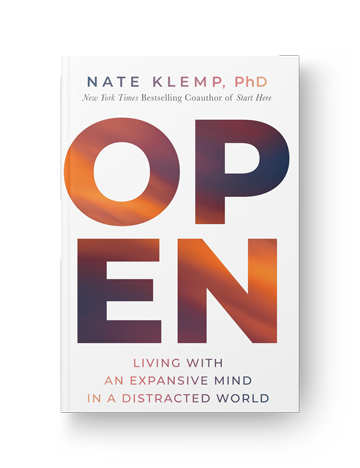
Here are five tools for creating mental space. If you want to go deeper, check out my new book with Sounds True on the topic called OPEN: Living With an Expansive Mind in a Distracted World.

1. Meditation.

You’ve no doubt heard about all of the scientifically validated benefits of this practice. It reduces stress. It boosts productivity. It enhances focus.

That is all true. But here is the real benefit of meditation: it creates more space in the mind. To get started, try it out for just a few minutes a day. Use an app or guided practice to help you.

2. Movement.

So, maybe you’re not the meditating type. That’s fine. You can still create space in the mind by setting aside time for undistracted movement.

The key word here is “undistracted.” For many of us, exercise and movement have become yet another time where our headspace gets covered over by texts, podcasts, or our favorite Netflix series. 

There’s nothing wrong with this. But it can be powerful to leave the earbuds behind every once in a while and allow the mind to rest while you walk, stretch, run, bike, swim, or practice yoga.

3. Relax.

When it comes to creating headspace, we moderns, with our smartphone-flooded, overly-stimulated, minds seem to inevitably encounter a problem: we’re often too stressed, amped, and agitated to open.

Relaxation – calming the nervous system – is perhaps the best way to counter this effect and create more fertile ground for opening. When we relax – the real kind, not the Netflix or TikTok kind –  the grip of difficult emotions loosens, the speed of our whirling thoughts slows, and, most important, the sense of space in our mind begins to expand.

How can you relax? Try yoga. Try extended exhale breathing, where you inhale four counts, exhale eight counts. Try yoga nidra. Or, just treat yourself to a nap.

4. See bigger.

When life gets crazy, the mind isn’t the only thing that shrinks. The size of our visual field also gets smaller. Our eyes strain. Our peripheral vision falls out of awareness.

What’s the antidote to this tunnel vision view? See bigger.

Try it right now. With a soft gaze, allow the edges of your visual field to slowly expand. Imagine you’re seeing whatever happens to be in front of you from the top of a vast mountain peak. Now bring this more expansive, panoramic, way of seeing with you for the rest of the day.

5. Do nothing.

Now for the most advanced practice. It’s advanced because it cuts against everything our culture believes in. In a world where everyone is trying desperately to get more done, one of the most radical acts is to not do — to do nothing.

Even just a few minutes of this paradoxical practice can help you experience an expansion of space in the mind.

Lie on the floor or outside on the grass. Close your eyes. Put on your favorite music if you want. Set an alarm for a few minutes so you don’t freak out too much. 

Then, stop. Drop the technique. Drop the effort. Just allow yourself to savor this rare experience of doing absolutely nothing.

Nate Klemp, PhD, is a philosopher, writer, and mindfulness entrepreneur. He is the coauthor of the New York Times bestseller Start Here and the New York Times critics’ pick The 80/80 Marriage. His work has been featured in the LA Times, Psychology Today, the Times of London, and more, and his appearances include Good Morning America and Talks at Google. He’s a cofounder of LifeXT and founding partner at Mindful. For more, visit nateklemp.com or @Nate_Klemp on Instagram.

Learn More
Amazon | Barnes & Noble | Bookshop | Sounds True

Erica Djossa: Releasing the Mother Load

What have we done to our mothers? Sociologists call our times “the era of intensive mothering,” a period in which moms must be it all and do it all for their children and families. Psychotherapist and maternal mental health specialist Erica Djossa has made it her mission to teach today’s mothers how to take care of their well-being in a sustainable way. In this podcast, Tami Simon speaks with Erica about her much-needed new book, Releasing the Mother Load, and the steps we can take to challenge the norms and change the culture around mothering. 

Enjoy this empowering discussion of: values-centered mothering; mothers as martyrs; the pressures facing a generation of “overinformed, overeducated, and overwhelmed” moms; equally sharing our household duties; the cost of cognitive or invisible labor; boundaries; using the “load map” to redistribute the work; “mom rage,” its roots, and the unique nature of anger in motherhood; identifying the “red light and green light” times for difficult conversations with partners (and sticking to them); overcoming perfectionism; self-compassion; re-parenting yourself while you’re parenting your children; the disempowering belief that I’m failing as a mom; effective self-care for moms (it’s not just bubble baths!); advice for making changes—start small; and more.

Note: This episode originally aired on Sounds True One, where these special episodes of Insights at the Edge are available to watch live on video and with exclusive access to Q&As with our guests. Learn more at join.soundstrue.com.

E7: Freedom: Letting It All Pass Through

Understanding your mind is a lifelong journey where you learn that thoughts are just like waves in the ocean that come and go. This involves recognizing that thoughts and feelings, whether positive or negative, arise from deeper patterns formed by past experiences. By aligning more closely with our true spiritual nature, we can experience a deeper sense of peace, free from the ups and downs of life.

For more information, go to michaelsingerpodcast.com.

© Sounds True Inc. Episodes: © 2024 Michael A. Singer. All Rights Reserved.