Customer Favorites

Relationships, the Brain, and Zero Negativity

Tami Simon speaks with Harville Hendrix, a therapist and educator with over three decades of experience working with couples and singles seeking intimate partners. The cofounder of the Institute for Imago Relationship therapy with his wife Helen, Dr. Hendrix has authored and coauthored a number of influential books on relationship psychology including Getting the Love You Want and Keeping the Love You Find, as well as the six-CD Sounds True audio learning course, Finding and Keeping Love. In this episode, Tami speaks with Harville about a biological explanation for the notion that opposites attract, what it might mean to recognize “otherness” in relationship, and the value of creating a relationship that is without judgment, or “living with zero negativity.” (57 minutes)

Mindfulness and the Brain – with Jack Kornfield ...

Mindful awareness creates scientifically recognized enhancements in psychology, mental functions, and in our interpersonal relationships. But how can we integrate this information into our personal or professional lives? In the Mindfulness and the Brain online course, Jack Kornfield, PhD, and Dan Siegel, MD, offer theoretical and experiential teachings on the power of inner transformation and the cultivation of a wise and loving heart. With thoughtful dialogue and practical tools, this interactive professional development training offers therapists, healers, educators, parents, meditation practitioners—and anyone else interested in developing a healthy mind—an intriguing exploration of what it means for us and our world to be able to shift our awareness.

Complete with memorable anecdotes and real-life stories that illustrate key concepts, Mindfulness and the Brain offers a comprehensive training with specific learning objectives including: utilizing mindful practice to help reduce suffering and promote resilience; how a “resonance circuit” enables an individual to attune to oneself and others; and incorporating intrapersonal attunement to catalyze mental, interpersonal, and psychological well-being. Via weekly video downloads, you’ll receive more than seven hours of progressive insights and teachings from these renowned experts as well as seven different practices and exercises on audio to use in your personal or professional life. To deepen your learning, two live interactive Q&A sessions will be offered with Jack Kornfield and Dan Siegel.

From thorough explanations of scientific findings and down-to-earth Buddhist perspectives to moments of stillness and laughter, Mindfulness and the Brain invites you to discover a more integrated and connected way of knowing and developing a wise and loving heart.

A Meditation + Writing Exercise to Conquer Your Fear

A meditation + writing exercise to conquer your fear, banner

To prepare for the dog days of summer, we move from amusement to audacity. Being a dog owner and lover, I particularly enjoy the expression “dog days.” I always picture a pile of lazy dogs panting away in the shade of a chestnut tree, waiting out the heat of the day to go for an evening walk. Venturing into the heat of creative and spiritual practice takes courage; it is an audacious undertaking.

This July, I invite you to take on a “BHAG”—a Big, Hairy, Audacious Goal. Write forth your truth and wake up to expanded awareness in the process. Whether that means starting a journal or writing a poem, novel, memoir, or letter to your grandmother, audacity will drive you forward. I want you to commit here and now to do your best in any given moment. Move forward with your best intentions of creativity and spiritual awakening at heart. This combined meditation and writing practice will help you get there.

A Meditation on Audacity

Let’s begin with where we are—in a grounded and courageous place, fully embodied. Find your comfortable place to sit. Rest your hands easily in your lap and your feet flat on the ground or cushion. Gently close your eyes. Take a few breaths inward and release. Find that natural rhythm of your breathing, connecting with your breathing body. Tune into your immediate sensory experience, just noticing what your experience is right in this moment. Let your breath be your anchor and ground.

See if you can bring to mind a particularly scary or vulnerable situation. Think of one in which you recently felt exposed, sensitive, even fearful; not one in which you were in a dangerous situation, but a memory of you putting yourself out there in some way—confronting someone, speaking to a group, asking someone new out on a date. As memories of the situation come to you, breathe deeply into your belly and know that you are safe now, breathing here in this moment in this body. If you need to, you can open your eyes, but try to remain grounded in your breathing body. Notice the rush of sensations and allow whatever arises to arise with love, patience, and compassion. Be gentle with yourself and remember that you are safe. See if you can stay with the feelings and simply explore how your fear or discomfort exists as a bodily sensation.

Notice where in your body you feel them. Breathe nurturing air into those places. Allow yourself to become familiar with the sensations of fear and vulnerability without the need to disconnect, distract, or avoid altogether. Be patient and kind with yourself as the emotions and feelings stream through. Gently note any physical changes: increased body heat, increased heart rate, tingling in your arms, increased sweating, and so on. Notice how the sensations linger, change, and dissipate. Become curious and open while kindly grounding yourself in the breath.

Put both hands on your heart, left on top of right, and take a deep breath. Say to yourself, “May I be well, may I be at peace, may I be bathed in the light of lovingkindness and compassion right now.” Take another deep breath, exhale, and release your hands. Bring them back together, palm to palm, at your heart and bow to yourself in gratitude for your courage and love. Open your eyes to complete the meditation.

You might try this meditation for five minutes at first and then extend it as you feel more audacious and courageous. The more you allow the feelings to arise and exist, the more familiar you will become with them. In turn, you will be better able to let them go and dissipate and see them for what they are—waves of energy and information arising and passing away.

Now for the writing . . . Write down three things you can do in the next month that scare you. They don’t have to be drastic acts such as speaking in front of 400 people. How about just sitting down to write that first scene of your novel? Typing up your first few poems? That can be scary enough. And these frightening endeavors don’t have to be related to writing. Maybe it’s a little terrifying to sit in meditation with your eyes closed for more than five minutes. Check in with yourself and see what’s a little scary for you—where can you push yourself a little further? Book a trip overseas, sign up for a rock-climbing adventure, agree to read at your local open mic. Keep in mind that you don’t have to actually do these things right now. Simply start by writing them down and sitting in their presence for a bit. Then you can take action to feel your fear and do it anyway!

This excerpt has been shortened and adapted from Writing as a Path to Awakening: A Year to Becoming an Excellent Writer and Living an Awakened Life.

A Meditation + Writing Exercise to Conquer Your Fear, Albert Flynn DeSilver


ALBERT FLYNN DESILVER is an internationally published poet, memoirist, novelist, speaker, and workshop leader. He has published several books of poetry, Beamish Boy, and his newest book, Writing as a Path to Awakening. He teaches at the Omega Institute, Esalen, Spirit Rock, and writing conferences nationally. He lives in Northern California. For more, visit albertflynndesilver.com.


A Meditation + Writing Exercise to Conquer Your Fear, Writing as a Path to Awakening, Albert Flynn DeSilver


Buy your copy of Writing as a Path to Awakening: A Year to Becoming an Excellent Writer and Living an Awakened Life at your favorite bookseller!

Sounds True | Amazon | Barnes & Noble | Indiebound


A Meditation + Writing Exercise to Conquer Your Fear, pinterest

Jules Blaine Davis: Meet the Kitchen Healer

For eons, women have gathered around the place of cooking—the fire, the hearth, the kitchen—to share wisdom and nourish each other through love and compassion and yes, food. In her new book, The Kitchen Healer: The Journey to Becoming You, Jules Blaine Davis celebrates the ways we nourish our bodies, hearts, and spirits in this cherished place. In our podcast, Tami Simon and Jules discuss how the kitchen gives us the opportunity to pause, grieve, and replenish—and to rewrite our stories over and over again. In true loving-healer fashion, Jules talks about our deep hunger to connect with each other in what has become “a cultureless culture,” and how the kitchen provides that essential space for reuniting with our longing, our joy, and each other. 

She shares her thoughts on the practice of simply being with our problems instead of fixing them, and how powerful it is to just give yourself an abundance of permission. Her joy and compassion radiate throughout this conversation, as does the promise of discovery through healing. Says Jules, “When we’re in the practice of healing, there’s no graduating from healing. We’re just unfolding. We’re unraveling. We’re becoming who we are over and over again in all the different beautiful places in our lives.”

Jacqueline Suskin: Being an Artist for the Earth

In our modern world, many of us live predominantly out of sync with the rhythms and cycles of nature and the Earth. In her new book, A Year in Practice, Jacqueline Suskin offers readers a wealth of teachings, tools, and rituals to realign with the four seasons and the transitions between them for creative insight and inspiration. 

Take a listen as Tami Simon speaks with the celebrated poet and author about the rewards we reap through a return to harmony with our immediate natural surroundings and our larger planetary home, in this conversation on: following your own creative impulse; letting the experiment be the guide; the shift from creative practice to profession; guesswork and trust; the Earth and the seasons as ever-present muse; the many faces of devotion and meaning-making; remembering our connection to nature on a daily basis; the importance of carefully tending to transitional times; the benefits of cultivating a greater sense of embodiment; balancing hope and hopelessness; the sacred function of the poet; the healing power of intentional rest, and the “medicine of winter” so many of us need; introspection, silence, and solitude; making the “radical return” to nature’s cycles; the poem “Desert Bear” and the metaphor of hibernation; shedding what’s no longer needed; and more.

Note: This episode originally aired on Sounds True One, where these special episodes of Insights at the Edge are available to watch live on video and with exclusive access to Q&As with our guests. Learn more at join.soundstrue.com.

Meet the Author of . . . A Healing Space

The Author

Matt Licata, PhD, is the author of A Healing Space: Befriending Ourselves in Difficult Times, coming out in November, 2020. In addition to being an author, he is a practicing psychotherapist and hosts in-person retreats. His work incorporates developmental, psychoanalytic, and depth psychologies, as well as contemplative, meditative, and mindfulness-based approaches for transformation and healing. He co-facilitates a monthly online membership community called Befriending Yourself, is author of The Path Is Everywhere, and is the creator of the blog A Healing Space. He lives in Boulder, Colorado. For more, visit mattlicataphd.com.
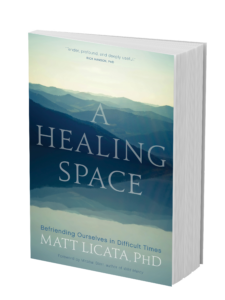
Healing Space Book Cover

The Book

Is healing a matter of solving a problem, curing a sickness, or making our wounds disappear? “In my experience,” writes depth psychotherapist and meditation teacher Matt Licata, “true healing is not a state where we become liberated from uncomfortable feelings, but one in which we are free and flexible to welcome our complete experience—whether happy or difficult—more fully.” With A Healing Space, Dr. Licata invites us to explore a more vital sense of wellness—one that does not put us in opposition to life’s hardship, but instead welcomes all experience as part of the soul’s majestic vastness.


Are you learning any new tricks or skills during this time (COVID)? Has your book taken on a new meaning in the world’s current circumstances? Is there anything you would have included in your book if you were writing it now?

One thing I’ve been struck by in this time of COVID is just how formative, powerful, and challenging solitude can be for each of us, and how through confronting our aloneness we will inevitably meet parts of ourselves that we had lost contact with in times of status quo. As relational beings, wired to connect and co-regulate with one another, it can be so counter-instinctive to be alone, for there to be an absence of “good others” in our lives, and how much we take this for granted.

What has become a lot clearer to me is how we can call on these “internal others” who, through many moments of kindness, attunement, empathy, and compassion, reside as an “internal network” within us, and how important this can be in times of physical separation—and how truly available they are, even from afar, in ways that might surprise us. 

I’m happy that A Healing Space is coming out during this time as it is centered around the art and practice of “befriending” and what that might mean in our contemporary world. Had I known that we would be sheltering in place and social distancing as we are, I would have more explicitly addressed the unique ways that isolation, solitude, and even loneliness can serve as actual allies on the path of awakening and healing, portals or doorways to a more merciful, wise, and compassionate relationship with ourselves and others.

What is one unexpected thing or habit that inspires your writing practice? 

So much of my writing comes out of conversations I have with others—friends, family, students, clients, and even strangers. I often find myself deeply curious and even in awe at how others find meaning in their experience, make sense of it, and organize it in ways that are similar—and also at times quite different—to my own. 

There’s something about being in conversation that opens me to another person’s heart, to their soul, to their psyche, and I often leave a conversation with new ideas, lenses, or reality tunnels, which I tend to explore via image and language. 

It’s sometimes not easy for me to “sit down and write” in a general and abstract way. It requires live interaction with another human being or with the natural world in order to flow. It’s almost like I wait to hear a certain whisper or inner song that arises from conversation and quickly scramble to be the scribe for that to come into the world.

If there is a book that started your spiritual journey, what was it? How old were you, and how did you discover it? How would you describe its impact?
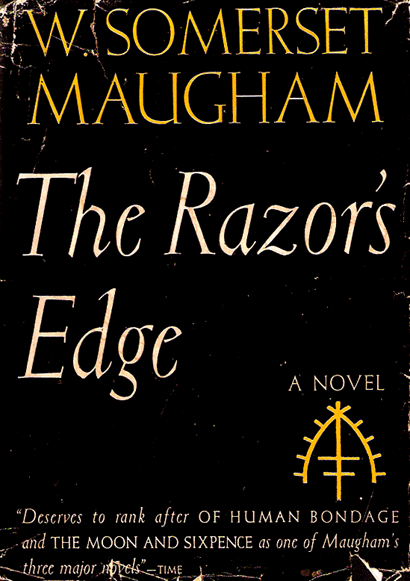
The Razor's Edge

The first overt “spiritual” book I remember reading was in my senior year of high school: The Razor’s Edge, by W. Somerset Maugham. I would have been 17 at the time and had always been a bit of a dreamer with a vivid imagination and deep curiosity and wonder as to whether I really belonged in this place. 

It was an identification with the protagonist, Larry Darrell, that catalyzed a certain longing in me, a knowing that there was more to this life than it appeared. To this day, I can return to some of those feelings I felt at the time, an opening or crack in reality, you might say, that invited me into a life of deeper meaning, magic, and aliveness. 

I reread the book while traveling in India in my early 20s and continued my connection with Maugham and with Darrell, especially with Larry’s journeys in India himself. I had a kindred spirit out there somewhere and I remember that meaning a lot to me at the time, that there was at least one other person who wondered and wandered in the same way that I did.

Healing Space Book Cover

Learn More

Sounds True | Amazon | Barnes&Noble | Bookshop | Indiebound