Customer Favorites

The radical path of space and kindness

As a psychotherapist who works with accomplished yogis, yoginis, meditators, and committed seekers and practitioners of all kinds, I have come to discover with my clients just how easy to use spirituality to hide from life – from intimacy, from our feelings, from our tender vulnerabilities, from our unresolved wounding around love, and from our immediate embodied experience in any of its moment-by-moment unfolding. We can deny, stuff, shut out, repress, and abandon our very real feelings of hurt, anger, disappointment, and jealousy because on some level they have been deemed very unspiritual, unacceptable, or further evidence of our own unworthiness. Or, we will act the feelings out—indulge, identify, and fuse with them – believing we are making actual contact, while spinning around their surface and doing whatever possible to discharge the disturbing energy which is seething underneath.

Depending on our specific, historic core vulnerabilities – which arose intersubjectively in our families of origin, as part of a relational matrix – certain feelings were simply not safe to embody, as they triggered anxiety in our caregivers, or otherwise led to their withdrawal of love, affection, mirroring and attunement. As young children, it was an act of kindness and creativity to split off, dissociate, and disconnect from material we were not developmentally capable of digesting and metabolizing on our own. We are wired to do whatever possible to maintain the tie to our caregivers, even if such tie is precarious, misattuned, or ultimately not in the interest of any sort of self-cohesion or integration.

As we engage over time in these strategies of denial and acting out – both pathways ultimately of fundamental aggression and chronic abandonment—we often find ourselves wondering why we are not feeling alive, connected, and truly able to open to others – why things just aren’t flowing for us in the ways we long for. We wonder why we don’t feel worthy of love, why we don’t know in some fundamental sense that we are loved or lovable exactly as we are. But a part of us senses that it is only in intimate and direct contact with our vulnerabilities, in all their forms, that we will know this aliveness and be able to truly take the risk that real embodied love will always demand.  As long as we are using spirituality to avoid intimacy, contact, and the depths of our own being – as long as it has become yet another means by which we can avoid our unlived lives – we will feel lonely at our core, disconnected, and split off from love.

As we start to discover the ways we are using spiritual ideas, beliefs, language, jargon, exercises, teachings, and practices to avoid relationship (with self and other), with as much kindness, space, and compassion as possible, we can return our attention into present, embodied experience. We need not shame ourselves in this discovery or deem it some evidence of our failure or unlovability. But rather use it as an opportunity to be curious about the strategies we’ve brought into adulthood to get away from very disturbing, survival-level panic and anxiety. And begin to open our hearts to this movement as the best way we’ve known to care for ourselves until now. For it is only radical kindness and space that will melt the wounds and tangles of love.

Like any defense mechanism, this relationship with spirituality has served an adaptive function and we can honor it for the help it has provided us at a particular point on our journey. And we can start slowly and with a mighty presence and compassion, to allow the protective function to dissolve, to reclaim full experiential responsibility for every feeling and emotion we’ve intelligently split off from, and step into the mandala of integration and wholeness, which is none other than our true nature. As we journey on the path of the heart and that of metabolization by love, re-owning and re-embodying to the entirety of what we are, we weave a sanctuary for the light and the dark within. And in this we become a holding environment for ourselves and others, more and more transparent and more and more translucent to the activity of the beloved in this world.

buddhamodern

Art by Gonkar Gyatso – “Buddha in Modern Times” 

Miracles at Work

Friends –

If you’re reading this, it’s safe to assume that you are on a spiritual journey.

Me too.

And the most transformative insight I’ve gained over many years of spiritual study is that love is the foundation of our being.

This sounds nice, of course, until you apply it at work.

Then things tend to get a bit messy.

That’s because we are told we have to be “tough” to get ahead, and yet for many of us, being tough feels out of alignment with love.

On the other hand, being “soft” feels—well, soft.

If you relate to this struggle, perhaps you’ve also made attempts to compartmentalize your “spiritual” self and your “business” self, only to feel lacking in both.

This is where A Course in Miracles comes in and where you can use the Course’s insight to achieve a high level of career success while honoring your sacred path at the same time.

In my new book, Miracles at Work: Turning Inner Guidance into Outer Influence, I’ve taken the basic principles of A Course in Miracles and translated them into dozens of practical tools that will enhance your experience and influence on the job, regardless of whether you are a student of the Course or not.  

As a small sample of what you can expect, I invite you to try this experiment from Miracles at Work:

Instead of viewing “love” as a gesture of affection, try thinking of it as a rejection of any littleness within your own mind. In this sense, love doesn’t mean running around your office in a cloying state of sweetness; rather, it becomes a moment-by-moment practice of dissolving any judgment that can lead to emotional instability. As a result, the more you remove the judgment, the more you will find yourself becoming a clear channel for the expression of compassion and wisdom towards yourself and others.

Far from being soft or naïve, I would argue that this is actually the most sophisticated way you can show up in the world – and in Miracles at Work I’ll show you how it’s done.

Let’s get started,

Emily


PS – Order Miracles at Work today and receive more than six hours of free bonus interviews. Click here for details.

What is Somatic Abolitionism?

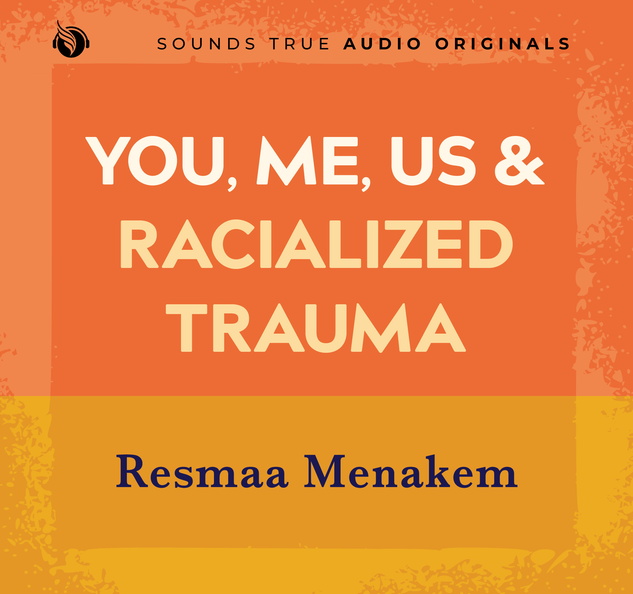
Somatic Abolitionism is a living, embodied anti-racist practice, a form of culture building, and a way of being in the world. In this immersive audio workshop, Resmaa Menakem presents ten sessions of insights and body-based practices to help listeners liberate themselves—and all of us—from racialized trauma and the strictures of white-body supremacy.

Listen to the first 15 minutes of this audio program:

https://soundstrue-ha.s3.amazonaws.com/video/You-Me-Us-Racialized-Trauma-Excerpt.mp4#t=,15

This is an adapted excerpt from You, Me, Us and Racialized Trauma by Resmaa Menakem.

You, Me, Us, and Racialized Trauma

Somatic Abolitionism is a living, embodied anti-racist practice, a form of culture building, and a way of being in the world. In an immersive audio workshop, Resmaa Menakem presents ten sessions of insights and body-based practices to help listeners liberate themselves—and all of us—from racialized trauma and the strictures of white-body supremacy.

Learn More

Breathe and Be


Need more “Breathe and Be” Moments?


Excerpted from Breathe and Be: A Book of Mindfulness PoemsWritten by Kate Coombs and illustrated by Anna Emilia Laitinen.

Kate Coombs is the author of numerous books, including picture books, novels, and books of poetry. Her collection of ocean poems, Water Sings Blue, won the Lee Bennett Hopkins Poetry Award for 2012. She’s a former teacher, and has taught both K-12 and college. Her favorite color is the blue-green at the top of an ocean wave, and she goes out of her way to step on dry leaves just to hear them crunch. For more, see katecoombs.com.


Anna Emilia Laitinen studied graphic design and illustration in Finland and Iceland. She has illustrated books, stationary, tableware, and textiles. In 2015, she received the Kaiku Award for illustration from The Association of Illustrators in Finland. Her favorite color is the Northern winter sky during sunset and her favorite sound is waking up in a tent in a forest full of birds singing. For more, see annaemilia.com.


The Sacred Art Of Taking A Bath


When I tell my students that one of the most magical things they can do is take a bath, I rarely have to say anything more, for we intuitively know that the time we take to shower and bathe is time touched by wild magic, and the space in which we do so is space imbued with the scent of the sacred.


Make Your Bath Sacred


Consider your own bathing rituals right here and right now. Begin with the fundamental question, “What needs to be washed away, removed, released?” And then, “What kind of bathing appeals to you the most?” A brisk shower or a slow bath? If you use products like bubbles, soap, bath salts, or body scrubs, why did you select them? Do you love to bathe in the privacy of your own home, or do you feel most connected to your remembered magic when you immerse yourself into a wildly running river, the cresting waves of a great ocean, or the green depths of a limestone spring? What elements need to be in place to change your bathing experience from one that is merely practical and about physically cleaning yourself to one that is also extraordinary and capable of washing away deeper marks and struggles?


Where do you feel dry?

Just as the land where we live contains water, our soul soil also holds swift rivers, vast oceans, and deep springs. These interior waters are the places understood to hold the human capacity for deep feeling and emotion, creativity, love and compassion, vitality and nourishment. And just like bodies of water in the surrounding world, our interior waters can be dammed up, walled off, covered over, and blocked in a variety of ways. These waters can also be polluted. Sometimes this is done by others or is a result of the toxic aspects of the culture at large, and sometimes we do it to ourselves without realizing it. Having set up house in multiple arid lands, I can tell you from firsthand experience that the presence or the absence water in our surrounding world presses us to ask hard questions about our internal waters. Consider where your life feels dry, uninspired, lacking creativity, fecundity, and fertility? Where are the places that have become too tough and hard and not nearly tender enough? Where has your soul soil been in drought for year upon year, so that all you can find there is dry dust and cracks in the ground? Where is the spark of life lacking or completely absent? 


Where do you feel in the flow?

After considering what makes you feel dried up and devitalized, consider the opposite. What calls up your life and creativity? What makes you feel like your inner landscape is well irrigated and flowing with wide rivers or caressed by ocean waves? What are the ways that you best clean up the hurt places in your life? What are the medicines that help you heal most readily and completely? Our work here calls us to an awareness of the places that feel broken, the parts of life and the stories, beliefs, and habits that devitalize us from the inside out. Working with water in an intentional manner can also highlight these places, for we become acutely aware of where precisely there is lack. It is natural to feel that there is not enough water in the whole world to slake the deepest soul thirst and soothe the most parched places of our hearts. It is true: there is not enough water in the world to quench that thirst. But there is enough water in each of us. When you live in a desert, as I have for most of my life, you come to know this as fact. There is good water, strong and flowing, usually many miles beneath the surface, and when the thunderclouds come in and the wind begins to blow just so, the sheer rocks themselves begin to usher forth rivers and streams, and the well that springs up from the deepest self carries on its waves life-bestowing and life-affirming blessings.


Don’t have time for a full sacred bath every day? Try these stepping stones instead!

Make moon water. Fill up a clear glass jar with water and leave the top of it open. Set it outside under a full moon. Drink it down the next morning and note the texture, taste, and feel of the water as you do. Notice too how your body feels after drinking it.


Create a sacred spray. Get a spray bottle, fill it with water, add a few drops of your favorite essential oils, and use this quick version of sacred water to spritz yourself and your home, as you like.


Give yourself a footbath. Fill a basin with warm water, and add a teaspoon of baking soda, some lemon and lime slices, and any essential oils you like. After soaking your feet, pick out an oil or lotion to anoint your feet. Cleansing and anointing the feet is an ancient practice that honors one of the most sensitive (and taken for granted) parts of our bodies.  


This is an excerpt from Making Magic: Weaving Together the Everyday and the Extraordinary by Briana Henderson Saussy.


Download a free Making Magic journal here.

Briana Saussy is a teacher, spiritual counselor, and founder of the Sacred Arts Academy, where she teaches tarot, ceremony, alchemy, and other sacred arts for everyday life. She lives in San Antonio, Texas. For more, visit brianasaussy.com.


Buy your copy of Making Magic at your favorite bookseller!

Sounds True | Amazon | Barnes & Noble | Indiebound


James Hollis: “Find What You Love and Let It Kill Yo...

By what lights do you live your journey? What fires your imagination? What stirs your curiosity? What asks of you something that is so deep within you that perhaps it hurts, but you can’t let go of it because it won’t let go of you? These are some of the “large questions” explored by Tami Simon and her guest, Jungian teacher and author James Hollis. Hollis is one of those authors who’s beloved by everyone who works at Sounds True—especially those of us who’ve entered the second half of life—and in this podcast, you’ll discover why. 

Listen now as Tami and Jim discuss his new book, Living with Borrowed Dust, sharing thought-provoking insights about: the evanescence of our human journey; making your life luminous; asking large questions, and how we lose contact with the inquiries that serve our individuation; fate versus destiny; the independence of the psyche; the ego’s need for control; dreams as “health correctives” and an avenue to the numinous; showing up for your “appointment” in life; trusting the wisdom of nature; how psychoanalysis helps us rewrite the self-limiting narratives that hold us back; the worst damage of trauma: identifying who we are with what happened to us; why we can’t solve certain problems, but we can outgrow them; courage and perseverance; paying close attention to your inner life; living in a culture of distraction; dialoguing with your soul; the paradox of passion; facing the abyss; taking advantage of the precious moments; learning to live with ambiguity; and more.

Note: This episode originally aired on Sounds True One, where these special episodes of Insights at the Edge are available to watch live on video and with exclusive access to Q&As with our guests. Learn more at join.soundstrue.com.

>
Copy link
Powered by Social Snap