Many indigenous cultures refer to the more-than-human worlds as people. Clouds, trees, stones, plants—all belong to their own community, speak their own language, and have their own relationship to the spirit that moves through all things. The first time I recognized these more-than-human communities and felt their presence strongly as an adult was when I had spent a lot of time in the woods and became fascinated with trees. I noticed that in some places, many American beech trees grew together, while in other places, eastern hemlock congregated. In the beech groves, the simple-toothed leaves quaked in the breeze; their smooth, grey trunks reminded me of the mallorn trees from The Lord of the Rings. I couldn’t help but feel the presence of elves in those beech groves!
In the hemlock groves, the shadows were deep and the earth moist. The deep green boughs stretched and gently bobbed on the breeze, light, buoyant, and mysterious. The hemlock groves were hushed. Silence and watchfulness permeated the hemlocks’ shadows. Families of white pine created sun-toasted auburn carpets of needles, soft and aromatic in the afternoon light. Their trunks climbed high into the sky, and their bluish-green pine needles shone bright and happy in the sun. A feeling of optimism and joy seems to ring out when white pine needles shimmer in the sunlight. Under these mighty trees were perfect places to lie down or to sit and lean against trunks, perfect places to take in the tranquility of the land.
Looking into the distance, I could see patches of forest green on mountain slopes where communities of evergreens lived, and then the grey patches in the fall from oaks and maples that had lost their leaves. Suddenly it hit me: these are communities, tribes, families. Before this, I had not really seen or felt the profound reality of community that exists among trees of the same species, trees that congregate. Now, when I look out at hills or mountains in the distance, I see the tribes of tree beings whose presence creates a tapestry of color and texture all across our forested lands.
Trees communicate and support one another. Forest ecology expert Peter Wohlleben refers to the nutrient and information exchange that exists among trees in the microbial network underground as the “wood wide web.” There is evidence that trees work together to keep elder trees alive and that they warn one another of danger. We are symbionts with trees, relying on the oxygen they provide while they rely on the carbon dioxide we exhale. There is a give and take, a reciprocity, that binds us to the trees, plants, and other members of our earth community, all of whom share the atmosphere, nutrients, and waters of this living earth. To think of trees as objects denies what they are. To think that way minimizes and flattens the complex and mysterious reality of their “treeness.” This objectification of the living earth, whether it be trees, minerals, or animals, also flattens our consciousness and experience, causing us to miss out on so much of the beauty, love, and wonder to be found in relationship with the earth. When we think of the earth as composed of so many life-less objects, we give ourselves permission to treat them as such. If we take the time to slow down, to be mindful and observe the land, trees, and other crewmates of spaceship Earth, we strengthen our ability to see the reality of life’s living connections.
Reciprocity
Keep close to Nature’s heart … and break clear away, once in a while, and climb a mountain or spend a week in the woods. Wash your spirit clean.
JOHN MUIR
Rewilding is a way of seeing and being in relationship to life, and it can include learning ancestral skills for survival. Tom Brown Jr., a great tracking teacher, emphasizes the profound role gratitude and thanksgiving played in what he learned from his teacher Stalking Wolf, a Lipan Apache tracker and spiritual teacher. To truly feel and connect with the miracle of any living thing, any gift of the Creator, whether a piece of wood being carved into a sacred pipe or a plant or animal being harvested for food, one must honor the other being’s sacrifice and give thanks for what is received from that being. All of life is an exchange of energy. To live, all living things must consume, and in turn, be consumed. There is no escaping this.
Of all the world’s wonders, which is the most wonderful?
That no man, though he sees others dying all around
him, believes that he himself will die.
YUDHISHTARA, The Mahabharata
To be awake to the wonder of life is to be in a state of constant thanksgiving, for this breath, this bite of food, this caress of wind, this sunset, this chance to grow and serve others. A society whose people are involved in harvesting their food from their environment will likely be a culture that appreciates and that values thanksgiving. I believe that our collective loss of reverence for nature is in part due to our disconnect from the origin of our food. Pulling a potato or carrot out of the soil provides a sensual, embodied experience of taking life. When we take life, we have a natural inclination to want to give back, to restore balance.
We all need to embrace the ethic of thanksgiving again so that we don’t take the biodiversity of earth for granted. We can’t pretend that the water and air we pollute aren’t the water and air we rely on for our survival, for our health and well-being. A great start for a thanksgiving practice is with the breath, the thing we rely on most and most immediately. The birds who fly in the sky fly on our very breath. The air sweeps all around us, moving clouds, bringing snow and rain, making waves, and flowing in and out of our bodies with the oxygen that allows us to exist. The air we breathe moves the leaves in the trees, creating beautiful sounds that soothe our souls. We can go weeks without food and days without water but only a couple of minutes without the gift of breath. Throughout the world, there are cultures that hold the air and the wind as holy, as life-giving forces. The entire yoga tradition revolves around the fundamentals of breath, which can unlock expanded states of awareness and foster deep insights.
Giving Thanks
When I exhale, I know that the carbon dioxide flowing out of me will be absorbed by plant life and that the oxygen they exhale will flow into me. In my lifetime, I will ingest many living things, fruits, vegetables, animals, and water, and one day, my body will return to the earth, and other living things will eat me.
We are only stewards of our bodies for a time. Every seven or so years, every molecule in this body will have been replaced, so that the me I think of as me is stable only in my mind. Who I really am is living in a dynamic state of reciprocity with the cosmos. Our planet, which includes us, is made up of elements generated in ancient star explosions. So, when we walk barefoot in the grass, stand at the entrance to a forest, or look up at the cool moon on an autumn evening, we can acknowledge that we are not simply receiving beauty from a heavenly body, that there is more going on. Through mindfulness we can hold an awareness of our situation, one in which we are suspended between using and being used, between eating and being eaten, between enjoying and being enjoyed.
When did people stop talking to the earth? How does one thank the moon for being all that the moon is? I’ve made a habit of speaking to trees, stones, salamanders, the wind, and any other relative I see outside. I speak to everything in nature. Why? When I speak to the forest, it feels as if my words are resonating not only in the cavities of my human body but also through the air, back into my eardrums, and bouncing on trees, leaves, and stones. When spoken from the heart to the living earth, my words express love for what I experience as my greater self. I know that hemlocks and stones do not understand the English language; I am not anthropomorphizing them. Yet I feel fuller and more connected when I give myself permission to speak to the land. When I converse with the earth, sometimes the wind blows suddenly, as if in response, or a squirrel will throw a pine cone out of a tree, which also feels like some kind of answer. I don’t think we need to feel so isolated on this earth, so cut off and separate. We can honor our reciprocity with all of life by opening up the channels of communication with the more-than-human world.
Practice of Giving Thanks to the Earth
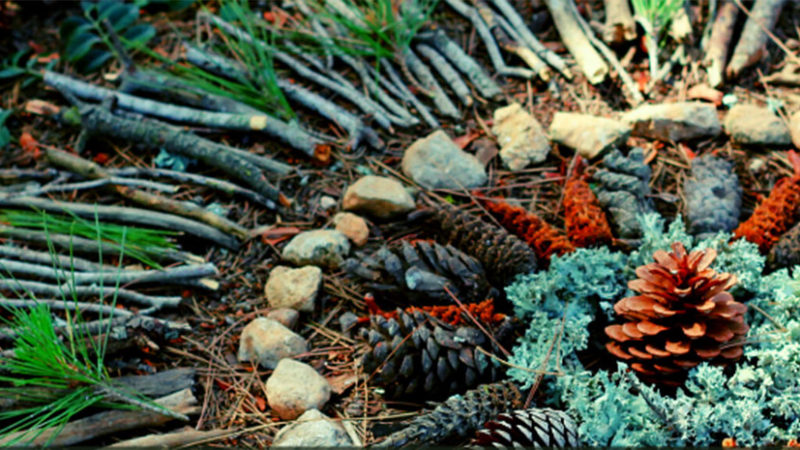
The next time you experience a perfect sunset, a refreshing walk through new fallen snow, or the gift of seeing a wild animal, consider offering a gesture of gratitude to the living earth. Drawing your hands to prayer in front of the heart and bowing to the light in that manifestation of the universe, you can simply say “thank you.” You might offer a small token, such as an acorn, pine cone, crystal, or small pebble, to show your thanks. You could also make an earth mandala, creating a circular symbol with natural objects you gather, and offer it with gratitude. As the days and months go by, the mandala will be received into the earth. You could also take a handful of water from a pond, lake, stream, bay, or ocean and speak your words of love and gratitude into the water, allowing your prayer to slip through your fingers and become one with the water of the earth. Maybe you would like to burn sage, palo santo, dried cedar, or another ceremonial incense of your choice, placing your intentions in the burning ember so that the rising smoke carries your prayer of gratitude and love to the heavens. These are small gestures, but they are powerful. These actions build a habit of focusing on the many ways we are in a deep state of interbeing with all of creation.
This is an excerpt from Rewilding: Meditations, Practices, and Skills for Awakening in Nature by Micah Mortali.