Customer Favorites

E199: Why You Cannot Fix the Inside from the Outside

Spiritual growth occurs when we stop identifying with our ego and recognize ourselves as the consciousness that observes thoughts, emotions, and experiences. By relaxing instead of resisting life’s inevitable challenges, we allow stored emotional blockages to dissolve and discover that external circumstances cannot permanently resolve inner suffering. As this process deepens, love, wisdom, and inner freedom naturally emerge, culminating in the realization of our unity with divine consciousness.

© Sounds True Inc. Episodes: © 2026 Michael A. Singer. All Rights Reserved.

Building the Bridge Between the Heart and the Mind

How can we drop what we are holding on to, if we do not first look for the hand that is grasping so tightly?

Have you ever noticed that you have two distinctly different personae and tend to vacillate between them?

One is very rigid and concerned with the outcome of everything. It worries and frets, its gaze mostly downcast. It doesn’t rest easily, even keeps you up at night sometimes. It acts almost like a dog chasing its tail. It circles obsessively over every detail and unknowable outcome, chasing the same things in a constant repeated pattern. It is cunning, convincing, and tyrannical in nature. It is feverish and ungrounded. Changing, morphing, and flopping from one story or idea to the next. This is your unharnessed mind. The persona you take on when your mind is not connected to the compass of the heart.

For most of us, that’s the dominant persona. But the other aspect of you, as if by some divine intervention, will from time to time slip past the censor of the mind and cheerfully take over your being with its boundless and uninhibited spirit. This personality doesn’t worry. Its face is often lifted, looking in wonder at the shifting sky and swollen moon. Lips curled into a slight smile. It is fluid and flowing, as if it’s on a river of unending joy. It acts like water and reflects light. You feel buoyant. This is your heart-centered self, your true self.

Because most of us moved into our mind long, long ago as a way of protecting our hearts, we now live most of our time in that rigid, concerned first persona. Without even realizing it, we allow our minds to stand between us and our true nature. We have no (conscious) idea how much our minds are acting as a defensive block against our soft and tender core, constantly at work trying to find ways to keep us from feeling, from hurt, from heartache. The price we are paying, however, is that we are also kept from accessing source.

In order to be heart minded, we need to bring the heart and mind into harmony and partnership with one another. For this to happen, we have to train the mind not to fear and close off from the heart, and instead, serve our heart and implement its wishes. In order to do this, we have to undo our mind’s association of feelings of the heart with hurt and harm. In situations that would ordinarily have us retreat or retaliate, we need to remain conscious of what’s happening and choose to soften and lean into our heart’s center. Each time we practice this softening, we send a new message to the mind that signals that we are safe, willing, and wanting to live in this more open, more sensitive way.

Over time, if we are resolute in our intention to step into our heart, our mind will become less rigid in its defenses against feelings and tenderness, and gradually we will become more heart centered.

Remember, we are not trying to pit the heart and mind against one another; we are trying to marry their aptitudes.

Let’s say a wave of anxiety washes through you. You notice your mind begin to race and attach to fearful thoughts. The anxiety then morphs into panic, which courses through you and makes you feel like jumping out of your skin. You begin reaching for an escape, resorting to some form of substance or distraction that can act as a numbing balm.

What just happened? Because you avoided your distress, you are only slightly comforted. A part of you remains braced under the distraction, in fear of the next time this could happen. Your mind’s instinct to protect and defend has been confirmed.

Your heart is neglected and still aching.

But let’s say a wave of anxiety washes through you and instead of looking for an escape route, you go to a quiet room to confront the feeling. You let go of the notion that something is wrong and respond as if something very right is taking place. You know some part of you is calling out for your love and attention.

Let’s say you close your eyes and open your heart to the bigness of the feeling. You create space around it simply by looking without resistance at its contours. You know the only antidote is self-love and hospitality. The mind stops racing away from the distress, which makes room for the heart to begin healing and soothing the body. Your mind learns a new route. You are gifted with courage and resilience.

The only difference between these scenarios was one simple choice: to remain a bystander as the mind continues to ignore the call of the body and heart or to act in ways that support leading from the heart, so the mind can follow.

The two can be wonderful allies if we let them.

As we become heart minded, we begin transforming our human experience from something out of our hands to something very much in them. We begin to cultivate joy instead of haphazardly stumbling upon it when we are willing.

Each moment, our bodies are counseling us to make choices that bring us closer to love. The wisdom of the heart and body is there for us, always, if we listen and let it lead.

For a guided practice in learning to stay in our hearts during difficult times, follow along with Sarah in this video.

 

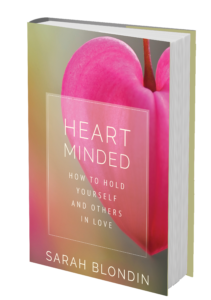
This is an adapted excerpt from Heart Minded: How to Hold Yourself and Others in Love by Sarah Blondin.

 

Sarah Blondin

Sarah Blondin is an internationally beloved spiritual teacher. Her guided meditations on the app InsightTimer have received nearly 10 million plays. She hosts the popular podcast Live Awake, as well as the online course Coming Home to Yourself. Her work has been translated into many languages and is in use in prison, recovery, and wellness programs. For more, visit sarahblondin.com.


Learn More

Sounds True | Amazon | Barnes & Noble | Bookshop

The Choice to Be an Artist at Work

Ari Weinzweig is the cofounder of Zingerman’s Community of Businesses, which includes Zingerman’s Deli and more than a dozen other food-based businesses in Ann Arbor, Michigan. He has also published a series of books detailing his unique philosophies on leadership and transformation, titled A Lapsed Anarchist’s Approach. With Sounds True, Ari is a featured presenter in the Inner MBA program. In this episode, Tami Simon speaks with Ari about his decision to forgo the franchise model and run his businesses from the heart—not unlike making art or writing poetry. They discuss the “visioning” process that Zingerman’s uses to grow in positive ways while staying true to their organizational roots. Ari also shares his personal recipe for transforming the beliefs that drive our behavior, both in business and in life.

Coleman Barks: Rumi, Grace, and Human Friendship

Tami Simon speaks with Coleman Barks, a leading scholar and translator of the 13th-century Persian mystic Jelaluddin Rumi. Coleman’s work was the subject of an hour-long segment in Bill Moyers’s The Language of Life series on PBS. He has published numerous Rumi translations, including with Sounds True the audio programs I Want Burning: The Ecstatic World of Rumi, Hafiz, and Lalla; Rumi: Voice of Longing; and his three-part collaboration with cellist David Darling called Just Being Here: Rumi and Human Friendship. In this episode, Tami speaks with Coleman about the extraordinary friendship between Rumi and his teacher Shams Tabrizi, and how translating Rumi requires entering a trance state. Coleman offers insights on grace as he and Tami listen to selections from Just Being Here


Click  here to listen to  Holiday Without Limits by Coleman Barks

Waking Up: What Does It Really Mean?

Adyashanti is a widely beloved, American-born spiritual teacher whose practice is rooted in Zen Buddhism but has expanded beyond any one path or perspective. He has created many books and audio programs through Sounds True, including Resurrecting Jesus, Emptiness Dancing, and Healing the Core Wound of Unworthiness. In this episode of Insights of the Edge—which previously appeared as part of the provocative interview series Waking Up: What Does It Really Mean?—Tami Simon and Adyashanti inquire deeply into what exactly constitutes “awakening.” Adya describes his own experiences of awakening, vividly comparing and contrasting his felt sensation of each of these life-changing experiences. Tami and Adya also discuss whether awakening is a sudden or gradual process, and what one can and cannot expect from these moments of profound epiphany. Finally, Adya shares his pith instructions on how to encourage such a spiritual awakening.

I Did a 40-Day Rest Cleanse and Here’s What Happened

For 40 days, I had the most soulful rest. And I did it in the comfort of my own home, with a full-time job, a family, and a social life.

Every day I awoke around 5:30 am and tiptoed to my Rest Cave (set up in a corner of our spare room). I laid on my back on an exercise mat (under my favorite blanket with a sleep mask) and plugged earbuds into my phone. Then I hit play on Karen Brody’s Daring to Rest yoga nidra meditation and let her soothing guidance lull me into a state of deep rest—or as Karen puts it, a return to myself. If you’re not familiar with yoga nidra, it’s a meditative practice for entering one of the deepest states of relaxation imaginable. And you do it lying down.

I’m not a morning person, but getting up to lie down (ironic, right?) was lovely. The stillness of the early morning quickly became my friend.

For the first 15 days, I listened to the Rest Meditation (20 minutes) to shed physical exhaustion, followed by 15 days of the Release Meditation (30 minutes) to let go of limiting beliefs. The last 10 days consist of the Rise Meditation (40 minutes), allowing life purpose exhaustion to lift, so that you can hone in on your true-hearted desires. Every five days I read a chapter in the book itself, Daring to Rest, for insight into what I was experiencing and supportive practices.

Gradually these aspects of my life began to shift—providing a depth of experience new to me, and oh so, beautiful.

  • An underlying sense of sweetness in my day. I discovered a natural flow to my day, felt light and at ease in my skin, and second-guessed myself less.
  • Deep intuition. Karen guided me to breathe in through my heart, then follow my breath, see where it landed, and listen for what she calls a “soul whisper”—a word or image that offers a clue to how you’re really feeling. Some days all I could think about was my to-do list or obsess over a worry. But when my soul whispers did arrive, they were often crystal clear and I journaled about them.
  • Patience and connection. Mornings were less frantic. When my seven-year old son had stressful moments getting ready for school, I felt calmer and more present for him. When we walked to the bus stop, my awareness of the outdoor world was more acute—the blue sky, cloud formations, the crescent of a morning moon.
  • Craving control. On days when I felt overwhelmed or anxious, my inclination to relieve those feelings with a glass of wine or binging on television lessened. Sometimes I would simply sit, gaze outdoors, and do nothing more. In those moments, I loved not feeling the need to do anything—not clean, not sort the mail, not check Facebook. I began to understand rest outside of my Rest Cave.
  • A connection to beyond. This was a big one. Karen calls it your “council of women” and teaches you to summon it for love and support. It can be women in your circle, women who have passed, even women you don’t know personally. I saw my grandmother (who died before I was born) looking at me lovingly and felt my sister-in-law, who I’ve known since I was a baby, standing beside me. At times the feeling of these and other women was so strong that tears ran down my cheeks.

While my life became deeper and rosier, it was not until I went cold turkey for a few weeks that I realized just how powerful this rest cleanse was.  I’ve always been someone who can go the distance, then neglect the sustaining part, like training for a half-marathon but not running for months after the race. And it’s so easy to fall back into old habits.

So now I’m learning how to translate this cleanse into an ongoing practice, for which Daring to Rest offers sound insights. My Rest Cave is an essential element. It’s not only a dedicated space for yoga nidra, but one for self-care in general—to journal, to listen to music, to just be.

Karen ends every yoga nidra meditation with the words, “Be good to yourself.” And in that spirit, I invite you to download her free Rest Cave Guide to create your own. And once you do, I dare you to rest and see what happens!

Christine Day has been a member of Sounds True’s sales and marketing team for more than five years and loves diving into our books on a personal level to learn both theory and practice. She also works on Sounds True’s children’s books and enjoys doing storytimes at her son’s elementary school.