Among the lessons I’ve seen people embrace by performing their microgestures is the true meaning of gratitude. Gratitude has become a big idea in certain circles these days, and a lot has been written about research showing that a focus on gratitude has real benefits for people in terms of their mental and physical well-being.3 This is probably why the practice of gratitude journaling has become so popular. You can even buy gratitude journals at your local bookstore ready for you to fill in the blanks about what makes you feel lucky today.
I have to admit that I have a bit of a bone to pick with the gratitude journalers of the world. It’s not that I disagree with the research or the idea that gratitude can be a powerful force. It’s that I think the idea of gratitude, perhaps because it has become so popular, is too often misunderstood.
I don’t believe that gratitude is about sitting in your room and saying thanks so only your walls can hear you. I don’t believe it’s something that should remain in the pages of a journal. I don’t believe it’s something you can find on a bracelet or in an Instagram quote. These can be good ways to remind yourself to be thankful, but they’re not enough. That’s because gratitude isn’t meant to be passive. “God is a verb,” as Paulo Coelho once said in an interview with Oprah Winfrey about his bestselling book, The Alchemist.4 I believe that gratitude, too, needs to be treated as an action.
In fact, we used to talk about gratitude in terms of giving thanks, which makes it sound so much more active, instead of merely being thankful. Rightly so, because I believe gratitude is something you should do, not something you merely think or feel or write about. This means you can’t just read in the news about the hurricane that devastated a town or the drug problem that plagues a community and feel thankful that you’re removed from it and safe. You can’t just walk by people in need and feel sorry for their suffering and grateful that you’re not in the same position. True gratitude is more than just a feeling. It’s the expression of that feeling through action—the action of serving others. To truly be grateful, you have to act gratefully.
It’s a bit like that old philosophical question about whether, if a tree falls in the woods and no one hears it, did it really fall? By the same token, if you love someone but you never express that love, either verbally or through your actions, can you really call it love? If you’re grateful for what you have but never extend that gratitude to others, then are you truly living a grateful life?
When we mindfully show our appreciation for what we have through the action of serving others, then gratitude is the result. It’s the byproduct of that service, and there’s really no other way to get it. We live in a world that loves shortcuts. If there’s a faster, easier, simpler way to get something done, then we’re all over it. People write about “life hacks” as if they’re going to save us, but some things can’t be hacked. I believe that gratitude is one of them.
In the energy exchange, there’s a dynamic between people made up of living, breathing energy that flows back and forth. When that energy stops moving, it dies. Gratitude has an energy behind it too, but I believe that energy dies, or at least atrophies, when we keep it confined to our thoughts and prayers or the pages of our journal. Even sharing grateful thoughts on social media—which I highly encourage as an antidote to all the complaints and judgments that tend to be put on display—is not the same as allowing our gratitude to inspire us to act on behalf of others. Because it’s so often relegated to contexts like these, gratitude is really in danger of losing its meaning.
I was once in a yoga class that was winding down on a hot day when I witnessed a missed opportunity to really live gratitude. We were all sitting in Lotus Position with the lights dimmed and the door open so the breeze could flow through the studio. Soft music was playing in the background and our hands were pressed together at our hearts as we whispered our “namastes.” Just then a man, who appeared to be suffering from mental illness, walked in through the open door to say hello and ask, “What are you all doing in here?” He was friendly
enough, but the reaction was immediate. The people closest to him scattered while others turned away or shook their heads. No one answered him. I meant to, but I didn’t gather my thoughts quickly enough. The teacher rushed over to tell him to leave, pushing him out the door and closing it behind him.
It was as if everyone in the room had forgotten what they’d been doing right before the man walked in. Yoga classes often end with the students saying namaste as an expression of gratitude for the experience they just had, the teacher who guided them through it, and the fellow students they shared it with. But it’s also generally considered to have spiritual connotations, to be a conscious acknowledgment of another person’s soul, of the divine light that resides in all of us. Some literally translate namaste from Sanskrit to mean: “The light in me acknowledges the light in you.”
I guess my fellow classmates decided that not everyone was worthy of a namaste. I don’t mean to be overly harsh. I get why people were frightened, as they often are by mental illness, or turned off by the disruption when they were in the midst of a peaceful moment. But if we’d all taken a moment to simply notice this man (an act of non-resistance), I think it would have quickly become clear that he meant us no harm. He was just curious and, I think, lonely. It seemed like what he wanted most of all was someone to talk to, and here he’d found a group of people expressing gratitude in a tranquil place. We can perhaps forgive him for thinking we were the kind of people who might be receptive to his attempt to connect.
We live in an amazing time. Being part of the Information Age gives us exposure to all kinds of wisdom and ancient teachings along with all the new. Yoga has been practiced for hundreds of years. Verses on gratitude can be found in the Bible. There is truth and power in these old ways, but let’s make sure we’re getting the most out of them. These ancient concepts should be more than just things you think to yourself or utter on autopilot. If we really want the benefits, we need to learn how to live them.
If you are grateful for something in your life, you have to find a way to put some of that grateful energy back into the world instead of holding onto it. That’s the only way to keep it flowing. That’s the only way gratitude can come back to you. If you have your antenna up while you perform your microgestures, you’ll start to notice the flow and you’ll start to better appreciate when some of it flows back your way.
❤ HEARTWORK ❤
Ask yourself: How can I do more than just think grateful thoughts? How can I act gratefully in the world today?
If you keep a gratitude journal, consider recording not just what you’re thankful for, but the full energy exchange: what you’re grateful for and what you gave gratefully in return.
Notes:
- Colby Itkowitz, “The Science Behind Why You Shouldn’t Stop Giving Thanks After Thanksgiving,” The Washington Post (November 24, 2016).
- Paulo Coelho, “What if the Universe Conspired in Your Favor?” Oprah’s SuperSoul Conversations (August 9, 2017).
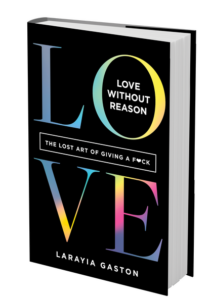
This is an excerpt from Love Without Reason: The Lost Art of Giving a F*ck by LaRayia Gaston.
 LARAYIA GASTON is a former model, actress, and founder of the nonprofit Lunch On Me, an organization dedicated to bringing organic, healthy food and holistic healing to those experiencing homelessness. She’s also a regular public speaker, podcast guest, and activist. She resides in Los Angeles. For more, visit lunchonme.org.
 Sounds True | Amazon | Barnes & Noble | Indiebound | Bookshop