6 Principles for Befriending Yourself: Part II

June 5, 2019

6 Principles for Befriending Yourself, Matt Licata, Jeff Foster


Enjoy this second installment in our new mini-series of Befriending Yourself, written by Jeff Foster and Matt Licata. Want to go deeper? Join their free webinar on Wednesday, June 5! Be sure to register here. 


In our previous excerpt (which you can view here if you missed it!), we discussed the first two principles of befriending yourself:

  1. STOP TRYING TO BE HAPPY (happiness is not something you can “do”)
  2. TRUE MEDITATION IS NOT WHAT YOU THINK (it’s what you are)


And now, we move on to Principles 3 and 4…


3.  “ONE MOMENT AT A TIME” (this one idea could save your life)

Don’t forget, befriending “what is” can only happen one moment at a time.

Actually, that’s all we ever have to face. A single present moment. Life is never truly bigger or more overwhelming than that. Present sounds, sensations, images, urges, impulses, fantasies, feelings, thoughts… we only ever have to process, digest or “deal with” a single instant of life.

Nothing more, nothing less.

Take some time to become curious about what you’re experiencing in a given moment of activation or trigger or stress, instead of shaming or blaming yourself (or others). Don’t abandon the moment when you need yourself more than ever.

Slow down, breathe deeply, open your senses, and acknowledge that you’ve become hooked, triggered, or thrown off center. You have to start by telling the truth of the moment, even if that’s humbling (which it often will be!). Start with, “I’m feeling overwhelmed,” or “I’m feeling really sad,” or “I feel completely lost and exhausted.” Know that this, too, is a holy moment, an invitation to meet yourself in a new way and to flood your experience with loving awareness. An invitation into that alchemical middle territory where the opposites (good and bad, right and wrong, sacred and profane) dance, where we discover the wisdom of immediate experience, and open to a new more creative response.

This “new, creative response” – choosing differently in a moment of overwhelm and activation – is what in neuroscience is referred to as neuroplasticity, that capacity of the brain to form new synapses, to encode new pathways, to rewire. Slowly, over time, as we familiarize ourselves more and more with this middle territory in between the extremes of denial and flooding, finding an “intimacy without fusion,” we begin to make new choices, fostering the miracle of neuroplasticity and the unlimited capacity of the human person to renew itself. This process, while having a scientific foundation, is in fact sacred, the expression of an outrageous sort of grace.

You don’t need to “be present” all day. Or even for a few minutes.

Don’t make “being present” into any kind of goal.

You only need to be present to a single moment.


Now.


It is essential to remember that staying with yourself for very short periods of time is what brings lasting transformation and change. We don’t need to “get in there” and resolve or root out our difficult experience, transcend, or purge it from our systems. This urge to “get to the root of it” (and quickly) is usually an enactment of earlier patterns of self-aggression and only reinforces in the nervous system that there is truly “something wrong.” By “very short periods of time,” we really do mean for a few seconds. For in that “few seconds” a revolution is born.

Over time, that “few seconds” very naturally expands, grows, and evolves on its own, organically as a byproduct of tending to ourselves in a new way, not from an urgent sense that something is wrong which must be fixed or healed very quickly. Trauma and other difficult experience can only unwind in an environment of love, of slow tending, of kindness. Yes, we can push ourselves a little, for a second or two more than might seem comfortable, for this will help us to build our tolerance and craft a scaffolding of love. But no more than that. Otherwise, we’ll just send ourselves outside our “windows of tolerance” and into overwhelm, retraumatization, all the while reinforcing the requirement that we meet future experience with fight-flight-freeze responses.

In other words, when you resist your experience, even very subtly by “trying” too hard to “be present” with it or even “accept” it, you’re still telling the body, there’s an enemy here, something I’m trying to get rid of.  When you slow down and go baby steps, moment by moment, you’re telling the body, it’s okay, I’m safe, this is uncomfortable and intense but I’m present with it, I’m safe. Once this requisite safety and resourcing is built into the nervous system – which happens slowly, one second at a time – then we can more organically, effectively, and compassionately begin to open our hearts to our pain, touch it with deeper levels of warmth, presence, and love, eventually even discovering that our pain is a true friend, an ally on the journey. But we cannot skip stages! We cannot just move straight to acceptance, forgiveness, and love from a field that is unsafe. It is an act of kindness and self-compassion to remember this and to honor where we are. While the mind may tell us, “Oh, just one or two seconds, big deal, can’t you do more than that? That’s not enough, you’ll never heal, you’re going too slowly, you’re falling behind, you’ve failed yet again,” in the reality of the nervous system and the heart, one second is the fertile soil of revolution.

Healing is not a competition. Remember, there is never any goal. There is no urgency on the path of love.

In the field of trauma, “titration” refers to tending to our difficult thoughts, feelings, and raw bodily sensations for a few seconds at a time, then stopping and shifting into a moment of self-nourishment and self-care, and then returning later, when we are ready. Pushing ourselves just a little, nudging ourselves gently into the dark and scary places, but not so much that we fall into overwhelm and flooding or dissociation.

Baby steps are courageous in this work and the material of revolution.

Moment by moment, even our dark and scary experience is bearable.

We cannot tend to the next moment’s pain and intensity, for that is truly overwhelming! We cannot “bear” a future moment of grief or loneliness. Just as we cannot experience or surrender to tomorrow’s sunrise, we cannot tolerate tomorrow’s – or even the next moment’s – fear or sorrow or pain. But we can come to see that this moment’s experience is workable. We can come out of tomorrow’s sadness, the next moment’s depression, and next week’s heartbreak into what is truly here now, which may be a lot more workable and tolerable than you think, not as devastating as you imagine, and in reality only a part of you that longs for a moment of your loving awareness.

A great inner confidence and trust and even joy can build from this. The joy of being alive and knowing we can meet anything life throws at us with courage and breath, slowness and presence. The joy of knowing that the Now is our true home and refuge. The joy of knowing that there is no such thing as a truly “unbearable” moment.


4. SUFFERING IS OPTIONAL (but sometimes pain and grief are inevitable)

What is worse, our pain… or our attempts to escape it (thereby making the pain into an internal enemy, mistake, or error)?

What is worse, our loneliness, fear, or sorrow… or our longing to be free from them, to get rid of them, to purge them from our being?

What is more painful, our pain, or our resistance to it, our refusal to experience it, the ways in which we hurt ourselves (and others) trying to numb ourselves from it? Abandoning ourselves in a moment when we long for true care?

What is worse, our difficult feelings, or the conclusions we’ve come to about what these experiences mean, the voices in the head about what these feelings say about us as a person (“I’m weak, I’m broken, I’m flawed, I’m damaged, I’m not whole, there’s something wrong with me…”) – the ways in which we judge ourselves for being the way we are?

What is worse, the rain as it falls, or our refusal to get wet?

We have come to believe that very ordinary human emotions, thoughts, and urges are in and of themselves the cause of our suffering and struggle. But is it the mere appearance of anger, sadness, disappointment, jealousy, uncertainty, or confusion that is really the problem? Or is it the abandonment of ourselves in the moment when these experiences arise? The shaming and judging of our authentic experience? The habitual conclusions we’ve come to – from our families, cultures, even our spiritualities – about what these very ordinary human experiences mean about us, our value, our worth, our progress along the path?

To take some time in our lives – in our inquiry, meditation, journaling, pondering – and really explore – this is a great gift we can give ourselves (and others). Just what is the source of my struggle and suffering? Is it true that I must convert my sadness to joy, doubt to clarity, rage to happiness, disappointment to gratitude, etc. in order to know true freedom, or is it a more radical invitation I am being called to? To not take anyone’s word for it – including our own! – but to become an alchemist or archaeologist of our own inner world and see.

It can be incredibly liberating and life-giving to discover that the freedom we are longing for is not found from these difficult experiences, but actually in them, at their very core. We continue to be amazed, astonished, and surprised as we witness those we work with as they go into their experience and illuminate this territory – and can be awed at the transformation that many are discovering in this inquiry. As Rumi reminds us, “The cure for the pain is in the pain” – this is a very profound alchemical truth that the ultimate medicine we are seeking is found inside the very wound itself. No, we cannot understand or make sense of this with the mind. But the body knows. The heart knows.

We need not “get rid of,” cure, transform, shift, or “heal” our immediate painful experience in order to be fully alive, connected, and free. When we come to see that it is not the thoughts and feelings, but the process of self-abandonment (turning from ourselves in a moment of activation, stress, or overwhelm and falling into the extremes of denial, repression, dissociation, or engaging in habitual or addictive behavior to cover over our pain) that generates so much of our unnecessary suffering, a new world opens.

Remember, difficult feelings and thoughts are like quicksand. The more you struggle against them, the more they suck you in. As we all know, we can quickly fall down the “rabbit hole” of cascading and looping thoughts and feelings, linking them together and weaving a very convincing story of how we’ve failed, done it wrong, are unlovable, and how there is fundamentally something wrong with us. But slowing down, pausing, feeling our feet on the ground, breathing deeply from our lower belly, we open into a new world. Gently allowing the thoughts and feelings to be here, breathing into them, even if they are intense and uncomfortable. Yes, it may feel counterintuitive to do this, but with some practice, you may come to experience them within the context of a lot of space. Even if they do not “go away,” somehow they release you from their grip when you call off the war and allow them to come and go, as they will by their very nature. Strangely, they may actually be your path to freedom. Release through relaxation, not endlessly “working on yourself” and turning your life into one unending project of self-improvement. We can start to see how even our spiritual and therapy goals can be yet another expression or enactment of a deep and core belief in our unworthiness, where “more” work on ourselves, paradoxically, begins another way to abandon and avoid ourselves as we are.

Of course, a certain amount of pain – physical and emotional – is inevitable, as long as we are alive. But begin to investigate how much of your pain is actually unnecessary. How much of your pain is actually resistance to your pain, thinking about your pain, ruminating on your pain, judging your pain, and judging yourself for having pain. How much of your suffering is actually self-created? You only have to deal with a moment at a time.


We hope you enjoyed this second installment in our new mini-series of Befriending Yourself, written by Jeff Foster and Matt Licata. Want to go deeper? Join their free webinar on Wednesday, June 5! Be sure to register here. 


ABOUT THE AUTHORS

JOIN JEFF FOSTER AND MATT LICATA EACH MONTH IN THEIR NEW “BEFRIENDING YOURSELF” MEMBERSHIP SITE: www.befriendingyourself.com

6 Principles for Befriending Yourself, Matt Licata, Jeff Foster

MATT LICATA

Matt Licata, PhD is a psychotherapist, writer, and independent researcher based in Boulder, Colorado. Over the last 25 years, he has been active in the ongoing dialogue between depth psychological and meditative approaches to emotional healing and spiritual transformation.

His psychotherapy and spiritual counseling practice has specialized in working with yogis, meditators, and seekers of all sorts who have come to a dead-end in their spiritual practice or therapy and are longing for a more embodied, creative, imaginative way to participate in their experience, in relationship with others, and in the sacred world.

Matt’s spiritual path and exploration has been interfaith in nature and includes three decades of study and practice in Vajrayana Buddhism, Sufism, Daoism, and Contemplative Christianity. His psychological training and influences have been in the larger field of relational psychoanalysis, Jung’s analytical and alchemical work, and Hillman’s archetypal psychology, to  name a few. He is the editor of A Healing Space blog and author of The Path is Everywhere: Uncovering the Jewels Hidden Within You (Wandering Yogi Press, 2017) and the forthcoming A Healing Space: Befriending Yourself in Difficult Times (Sounds True, 2020). His website is www.mattlicataphd.com


JEFF FOSTER

Jeff Foster studied Astrophysics at Cambridge University. In his mid-twenties, struggling with chronic shame and suicidal depression, he became addicted to the idea of “spiritual enlightenment” and began a near-obsessive spiritual quest for the ultimate truth of existence. The search came crashing down one day, unexpectedly, with the clear recognition of the non-dual nature of everything and the discovery of the “extraordinary in the ordinary.” Jeff fell in love with the simple present moment, and was given a deep understanding of the root illusion behind all human suffering and seeking.

For over a decade Jeff has been traveling the world offering meetings and retreats, inviting people into a place of radical self-acceptance and “Deep Rest.” He has published several books in over fifteen languages. His latest book is The Joy of True Meditation: Words of Encouragement for Tired Minds and Wild Hearts (New Sarum Press, 2019). His website is www.lifewithoutacentre.com


Jeff Foster

Photo of ()\

Jeff Foster shares from his own awakened experience a way out of seeking fulfillment in the future and into the acceptance of "all this, here and now." He studied astrophysics at Cambridge University. Following a period of depression and physical illness, he embarked on an intensive spiritual search that came to an end with the discovery that life itself was what he had always been seeking.

Foster, Jeff © Emily Goodman


Listen to Tami Simon's in-depth audio podcast interviews with Jeff Foster:
The Deepest Acceptance »
The Deepest Acceptance: Part 2 »
Unconditioned Awareness and the Challenges of Everyday Life »

Matt Licata

Matt Licata, PhD, is a practicing psychotherapist and hosts in-person retreats. His work incorporates developmental, psychoanalytic, and depth psychologies, as well as contemplative, meditative, and mindfulness-based approaches for transformation and healing. He co-facilitates a monthly online membership community called Befriending Yourself, is author of The Path Is Everywhere, and is the creator of the blog A Healing Space. He lives in Boulder, Colorado. For more, visit mattlicataphd.com.

Author photo © Krista Marleena

Listen to Tami Simon's in-depth audio podcast interview with Matt Licata:

The Alchemy Of Befriending Ourselves In Difficult Times  »

Also By Author

Victory! A Poem

Victory!

By Jeff Foster


You don’t have to be the best. 

You don’t have to win. 

You only have to be yourself.


You only have to be real. 

And speak from the heart. 

And know that you have the right to see how you see, 

and think how you think, and feel what you feel, 

and desire what you desire.


You don’t have to be a success in the eyes of the world 

and you don’t have to be an expert on living.


You only have to offer what you offer, 

breathe how you breathe, make mistakes and screw 

up 

and learn to love your stumbling and say the 

wrong thing 

and stop worrying so much about impressing anyone 

because in the end you only have to live with yourself


and joy is not given but found in the deepest 

recesses of your being 

so there can be joy in falling and joy in making 

mistakes 

and joy in making a fool of yourself and joy in 

forgetting joy 

and then holding yourself close as you crumble to 

the ground 

and weep out the old dreams.


Joy is closeness 

with the one you love: 

You.


You don’t have to be the best. 

You really don’t have to win.


You only have to remember this intimacy with 

the sky, the nearness of the mountains and feel the sun 

warming your shoulders and the nape of your neck


and know that you are alive, 

and that you are a success at being alive, 

and that you have won already, 

and you are victorious already, 

without having to prove 

a damn 

thing.


To anyone.

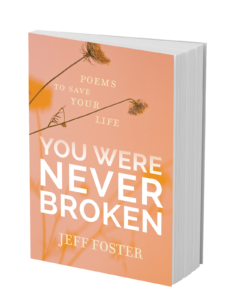
This poem is excerpted from You Were Never Broken: Poems to Save Your Life by Jeff Foster.


jeff fosterJeff Foster shares from his own awakened experience a way out of seeking fulfillment in the future and into the acceptance of “all this, here and now.” He studied astrophysics at Cambridge University. Following a period of depression and physical illness, he embarked on an intensive spiritual search that came to an end with the discovery that life itself was what he had always been seeking.


book cover

Learn More

Sounds True | Amazon | Barnes & Noble | Bookshop

The Courage to Stand Alone

The Courage to Stand Alone

It can be scary when we are called to confront our aloneness, the seemingly infinite depths of that empty, homeless feeling inside of us. When all our old protections fall away and the abandoned and neglected ones inside come begging for our love and attention. It can feel sometimes as though there’s nowhere to turn, like we want to crawl out of our own skin, urgently get out of the Now and into some other time or place.

It takes bravery to stop, breathe, and—slowly, slowly, slowly—turn back toward the lonely, dark, empty “void” inside (in reality, there is no void). To actually turn to face the sense of abandonment buried deep within our guts, to soften into the sense of separation that has been with us for as long as we can remember. We don’t have to make the feeling go away today, only lean into it, breathe into it, begin to make room for it, maybe even learn to trust its presence. 

quote image

Perhaps loneliness is like a cosmic nostalgia, a preverbal memory of a deep womb-connection, with ourselves, with the planet, with every being who has ever lived. In leaning into our own loneliness, shame, and existential anxiety, we may be able to touch into compassion for the loneliness of every human being, for every heart longing to connect, for every grieving heart, every frightened heart. 

We are alone, yet never alone. This is the great paradox of existence. Our loneliness, when not resisted or numbed away, may actually end up connecting us more deeply to life and each other, like it did for me and my sweet father that winter evening. 

Let us learn to be alone, then! Alone, without distraction, which is true meditation. Alone, communing with the breath as it rises and falls. Alone with the mind and its incredible dance. Alone with the rain and the morning sun. Alone with the crackle of autumn leaves under our feet, or the crunch of winter snow. Alone with the hopes and joys and anxieties of this human form, living a single day on this remarkable planet. Alone with our precious selves, with this unfathomable sense of connection to all things, with birth and loss and death and their myriad mysteries. 

Alone, with all of life.

This is an excerpt from You Were Never Broken: Poems to Save Your Life by Jeff Foster.

jeff fosterJeff Foster shares from his own awakened experience a way out of seeking fulfillment in the future and into the acceptance of “all this, here and now.” He studied astrophysics at Cambridge University. Following a period of depression and physical illness, he embarked on an intensive spiritual search that came to an end with the discovery that life itself was what he had always been seeking.


book image of excerpt on lonliness

Learn More

Sounds True | Amazon | Barnes & Noble | Bookshop

Into the Belly of Meditation

Into the Belly of Meditation

By Jeff Foster


You are weary, friend. 

Sit. 

You are thirsty. 

Here. Drink.


You are hungry. Here. Take this. 

A piece of bread. 

A small bowl of soup. 

See how God has taken form! 

It is all I have but it will keep you alive.

image 1

I will light a fire that will never go out. 

A sacred flame. Unconditional in its burning. 

To illuminate us in the darkness.


Oh. I see you are wounded. 

Bruised. Bleeding.

Exhausted from the world. 

You have suffered much, I know.


image 2

Come. 

Take off these dirty rags. 

Don’t worry. It’s safe. 

There is strength in your nakedness.


Here. Wash. 

Rub this medicine onto your wounds.


Put on these robes, they are clean and dry. 

Lie down. Close your eyes. 

I will watch over us tonight.

image 3

Listen. You have not failed. 

I see new life breaking through. 

I see birth. An insurrection. 

The sharp edge of hope.


I have no teaching for you. 

No wise words.


I only want you to trust what you are going through. 

To bring this fire inside of you.

Until the end.


I have known this pain. Yes

This courage to keep moving. Yes

This courage to rest, too.

The sacrifice of the known world.

image 1

Friend. 

Drop into the belly of meditation now. 

The place you were always seeking. 

The vast silence at the Earth’s core which is your own core. 

Breathing into the gut now. 

The throat. The chest. 

Irradiating the nervous system with unspeakable 

tenderness. 

Flooding the body with soft, warm light. 

Drenching the human form with divine love. 

And sleep. 

And sleep.

image 2

I may not be here when you wake. 

We may not meet again in form.


Yet I leave you with all you need. 

Food. Water. A bed. 

A chance to rest. 

A touch of kindness.

And your unbreakable Self.

flowers

This poem is excerpted from You Were Never Broken: Poems to Save Your Life by Jeff Foster.


jeff fosterJeff Foster shares from his own awakened experience a way out of seeking fulfillment in the future and into the acceptance of “all this, here and now.” He studied astrophysics at Cambridge University. Following a period of depression and physical illness, he embarked on an intensive spiritual search that came to an end with the discovery that life itself was what he had always been seeking.


you were never broken cover

Learn More

Sounds True | Amazon | Barnes & Noble | Bookshop


You Might Also Enjoy

Try These Mindfulness Exercises To Ground Yourself

Mindfulness is an ancient, deeply personal practice that invites you into the present moment with compassion and awareness. And yet, for many of us, simply “being present” can feel elusive. We’re managing careers, relationships, health, and the constant pull of digital life. It’s no wonder anxiety and stress have become everyday companions. Through regular, intentional practices, we begin to notice the quiet steadiness underneath the noise. That’s where grounding lives.

For over 40 years, Sounds True has been a trusted leader in spiritual education and personal transformation, sharing the wisdom of teachers like Eckhart Tolle, Pema Chödrön, Tara Brach, and many others. As the world’s largest “living library” of transformational teachings, we’ve helped millions of people reconnect with presence, purpose, and their inner wisdom through unscripted, heart-centered resources.

In this piece, we’ll explore a series of mindfulness exercises to support your return to presence, whether you’re seeking mindfulness exercises for anxiety, tools for teens and adults, or daily mindfulness exercises for stress relief. You’ll also find soulful practices like inner rhythm meditations woven throughout to help you tune into your natural flow.

Key Takeaways:

  • Learn Audience-Specific Practices: This article offers tailored mindfulness exercises for anxiety, adults, teens, and daily stress relief.
  • Find Practical and Accessible Tools: Readers will find easy-to-implement, non-intimidating exercises they can begin using right away.
  • Integrating These Exercises into Daily Life: Meditation exercises encourage integrating mindfulness into ordinary activities for long-term emotional grounding and resilience.

Expand Your Consciousness With Sounds True.

Simple Mindfulness Exercises To Bring You Back To Center

Even the busiest mind can come back to stillness with a few moments of intention. These foundational mindfulness exercises are designed to be accessible, grounding, and easy to integrate into daily life.

Breathe For One Minute

This micro-practice is a gentle reminder that your breath is always available as an anchor. Set a timer for just 60 seconds. Sit or stand comfortably. Close your eyes if you’d like. Bring all of your awareness to the sensation of breathing, how the air enters and leaves your body, and how your chest rises and falls. Don’t change anything. Just notice. One minute of conscious breathing can create space between stimulus and response, making it a beautiful starting point for mindfulness exercises for anxiety or moments of stress.

Ground Through The Five Senses

When your thoughts are racing or your emotions feel overwhelming, coming back to your senses, literally, can reset your nervous system. To practice this, look around and quietly name five things you can see, four things you can touch, three things you can hear, two things you can smell, and one thing you can taste. This kind of sensory awareness anchors your attention in the here and now, making it one of the most reliable mindfulness exercises for stress relief.

Notice Without Fixing

Mindfulness isn’t about making anything go away. It’s about seeing clearly. Try sitting in silence for a few minutes, simply noticing your thoughts, sensations, and emotions without trying to change or solve them. Let everything be as it is. This witnessing awareness is central to many mindfulness exercises for adults, a reminder that your worth isn’t based on productivity, performance, or emotional “control.” Instead, it’s grounded in the simple act of being present.

Mindfulness Exercises For Anxiety And Overwhelm

Anxiety often pulls us into the future, into what-ifs, worst-case scenarios, and mental loops that feel impossible to exit. Mindfulness brings us back to now. These exercises aren’t about eliminating anxiety, but about meeting it with gentleness, spaciousness, and embodied awareness.

Anchor To The Present With Touch

When anxiety feels like it’s spiraling, physical touch can be incredibly grounding. Place one hand on your chest and one on your belly. Feel the rise and fall of your breath beneath your hands. You don’t need to breathe in any special way, just notice the contact. This creates a direct, calming feedback loop that reminds the body it’s safe to soften. Practices like this are especially helpful when exploring mindfulness exercises for anxiety that are simple and body-centered.

Name What’s True In This Moment

A powerful way to interrupt anxious thoughts is to name what is real right now. Quietly say to yourself: “Right now, I am sitting on a chair. My feet are on the floor. I am breathing. I am safe.” You can add more statements based on your environment or sensations. This kind of mindful self-talk offers the brain a stable narrative to hold onto when anxiety is trying to pull you elsewhere. It’s a core part of how many people approach mindfulness exercises for stress relief as well.

Return To Ritual

When anxiety is chronic or persistent, creating small, daily routines can provide a sense of continuity. This might be lighting a candle before meditation, washing your hands slowly and with full attention, or taking a short mindful walk at the same time each day. These are quiet acts of devotion that bring structure to emotional chaos. For many adults, integrating mindfulness exercises helps create a sense of calm and inner order.

For a deeper experience of this rhythm-based approach, practices like inner rhythm meditations can support a more attuned, embodied return to presence.

Awaken Your Inner Healing Power With Sound True.

How Adults Can Use Mindfulness To Reconnect

Adulthood often brings a gradual disconnection from inner life. The constant push to do more, fix more, and be more can drown out the quiet voice within. Mindfulness gives adults a way to return, to presence, to embodiment, and to what matters most. It’s less about adding something new and more about softening into what’s already here.

Practices like breath tracking, gentle movement, or body scanning help rebuild that inner relationship. These mindfulness exercises for adults aren’t about achieving calm; they’re about creating space for honesty and self-awareness. Even simple routines like morning stillness or mindful transitions between tasks can foster deep reconnection.

Supporting Teens With Mindfulness Tools

Teenagers today are navigating an overwhelming mix of stimulation, pressure, and emotional intensity, often without the tools to process it all. Mindfulness can offer teens a way to slow down, feel what they’re feeling, and build emotional resilience from the inside out.

Unlike adults, teens often benefit from shorter, more tactile practices that meet them where they are. Movement-based mindfulness, breath-focused exercises, or even mindful listening with music can help create moments of pause without feeling forced or overly formal. These mindfulness exercises for teens aren’t about “fixing” behavior, but rather they’re about helping young people relate to themselves and their experiences with more kindness and awareness.

Meditation can also be incredibly empowering for teens to choose their own practice. Whether it’s a brief body scan before school or a silent check-in before sleep, creating space for autonomy makes mindfulness feel like a supportive resource rather than another rule to follow. Integrating accessible resources like inner rhythm meditations can also help teens begin to understand their emotional patterns and physical rhythms in a more grounded, compassionate way.

Daily Mindfulness Exercises for Stress Relief

Stress thrives on momentum. It builds, layer by layer, until we’re no longer responding to life; we’re reacting to it. Mindfulness breaks that cycle. Through small, intentional practices, we create pockets of stillness that allow the nervous system to reset and the body to soften.

Daily mindfulness exercises for stress relief don’t need to be elaborate. A few minutes of conscious breathing before checking your phone, taking a mindful walk after lunch, or simply pausing to feel your feet on the floor between meetings can shift your entire internal state. These moments act like pressure valves, gently releasing stored tension before it accumulates.

Repetition is key. The more frequently you return to yourself, the more familiar that calm becomes. Over time, the body begins to recognize presence as its home base, not stress. For those who feel especially drained or dysregulated, incorporating inner rhythm meditations can help guide you back to your body’s natural flow and restore balance from within.

Whether you’re navigating a high-stress job or simply feeling emotionally stretched, these simple yet consistent practices can anchor you in a steadier way of being and offer a meaningful alternative to burnout.

Explore Teachings From World-Renowned Psychologists And Researchers On Trauma, Mindfulness, Resilience, And Cognitive Growth.

Final Thoughts

More than something to master, mindfulness is something you remember as time goes on. A gentle return, over and over again, to the breath, the body, and the moment you’re living right now. These practices don’t promise a life free from stress or anxiety. Instead, they offer a way to meet life with more presence, compassion, and steadiness.

Whether you’re exploring mindfulness exercises for anxiety, integrating mindfulness into adult life, supporting a teen, or simply seeking stress relief, the power lies in consistency. Even the smallest pause, repeated with care, can rewire your relationship to the world around you, and within you. Above all, mindfulness is not a task to accomplish but rather it’s a path to walk, one breath at a time. Every time you return, you deepen your connection to yourself, and that is where healing begins.

Read More:

Frequently Asked Questions About Mindfulness Exercises

What are the core components of a mindfulness exercise?

A mindfulness exercise typically includes intention, focused attention (often on the breath, body, or senses), non-judgmental awareness, and a return to the present moment. These elements work together to train the mind in presence and compassion.

How long should I practice mindfulness each day?

Even 5–10 minutes daily can be effective. The key is consistency. Start small and gradually extend the time as it feels natural. Mindfulness is about presence, not perfection.

Are mindfulness exercises religious?

No. While mindfulness has roots in contemplative traditions like Buddhism, modern mindfulness practices are secular and adaptable to all belief systems.

Can mindfulness exercises help improve sleep?

Yes, practicing mindfulness before bed can help calm racing thoughts, ease physical tension, and prepare the nervous system for restful sleep.

Is it normal to feel distracted during mindfulness practice?

Absolutely. Distraction is part of the process. The goal isn’t to stop thoughts, but to notice when the mind wanders and gently bring it back to your point of focus.

How do I know if mindfulness is working?

Results are often subtle at first, like feeling slightly calmer, more aware, or less reactive. Over time, many notice improved emotional regulation and clarity.

Can children benefit from mindfulness exercises too?

Yes, children can benefit greatly from age-appropriate mindfulness tools, as these help them recognize emotions, improve focus, and develop emotional resilience early on.

What’s the difference between meditation and mindfulness?

Mindfulness is a way of being present in daily life, while meditation is a formal practice that often cultivates mindfulness. You can practice mindfulness without meditating.

Do I need to sit still to practice mindfulness?

Not at all. Walking, stretching, eating, and even washing dishes can all become mindfulness exercises when done with full attention and presence.

Can mindfulness help with physical pain?

Yes, mindfulness can change your relationship to pain by reducing resistance, softening tension, and increasing awareness without judgment. It doesn’t eliminate pain, but can make it more manageable.

Michelle Cassandra Johnson is an author, activist, spiritual teacher, racial equity consultant, and intuitive healer. She is the author of six books, including Skill in Action and Finding Refuge. Amy Burtaine is a leadership coach and racial equity trainer. With Robin DiAngelo, she is the coauthor of The Facilitator's Guide for White Affinity Groups. For more, visit https://www.michellecjohnson.com/wisdom-of-the-hive.

[ENCORE EPISODE] Jon Kabat-Zinn: Befriending Pain

**SPECIAL ENCORE PRESENTATION**

Current statistics tell us that 20% of the US population has some form of chronic pain, defined as severe discomfort that has continued for six months or more. That’s more than 50 million people. Jon Kabat-Zinn has received international acclaim for his leading work in bringing the life-changing practices of meditation and mindfulness into the mainstream of medicine and society. In this inspiring podcast, Tami Simon speaks with Jon about his empowering new book, Mindfulness Meditation for Pain Relief, and how we can greatly improve our lives (and our entire world) by reframing the way we relate to our thoughts, our minds, and the sensations of our bodies.

Listen in as they discuss the epidemic of chronic pain and the power of mindfulness to ease suffering of all kinds, the myth of the “good meditator,” the body as the starting point for practice, exploring your “emotionally freighted thoughts,” our longing to be who we really are, working with the mind and learning to inhabit a space of embodied awareness, the refuge that is meditation practice, letting go of our stories, befriending the sensory field of what we call pain, the miracle of life on Earth, the Buddha’s teaching on mindfulness as the direct path to liberation, surfing the waves of your own experience, unity within diversity and the arising of compassion, focusing on what’s right instead of what’s wrong, how we are all on a growth curve on life’s journey, and more.

Note: This episode originally aired on Sounds True One, where these special episodes of Insights at the Edge are available to watch live on video and with exclusive access to Q&As with our guests. Learn more at join.soundstrue.com.

This episode is sponsored by BetterHelp. Listeners of Insights At The Edge get 10% off their first month at

www.betterhelp.com/soundstrue

[ENCORE EPISODE] Anne Lamott: Radical Self-Care Change...

**SPECIAL ENCORE PRESENTATION IN SUPPORT OF WORLD MENTAL HEALTH DAY**

Anne Lamott is the celebrated author of many books of fiction, essays, and memoirs. Her works include Bird by BirdHallelujah Anyway, and Crooked Little Heart. In this special edition of Insights at the Edge originally recorded for The Self-Acceptance Summit, Tami Simon speaks with Anne about acts of “radical self-care” and how they are essential for anyone’s well-being. Anne talks about self-acceptance as an inherently feminist concept, especially around issues of body image and self-esteem. Finally, Anne and Tami discuss how it is necessary to fully accept oneself before being able to show up for others, and why modern society often argues the opposite.

Note: This episode originally aired on Sounds True One, where these special episodes of Insights at the Edge are available to watch live on video and with exclusive access to Q&As with our guests. Learn more at join.soundstrue.com.

This episode is sponsored by BetterHelp. Listeners of Insights At The Edge get 10% off their first month at www.betterhelp.com/soundstrue.

  • Tui says:

    The idea of micro – meditations has been around for a long time now. However, neuroplasticity doesn’t seem to be explained and understood fully by the author of this text.

  • >
    Share via
    Copy link
    Powered by Social Snap