Customer Favorites

Anita Moorjani: Embodying Love in a Fear-Based World

How do we stem the tides of fear and aggression sweeping over our divided world? How can we spread the love that heals and uplifts everyone? Sharing insights from her bestselling book, Dying to Be Me, and her latest work, Sensitive Is the New Strong, Anita Moorjani offers her hope-giving answers to these questions of compelling urgency for our times. 

Tune in for this remarkable teacher’s inspiring (and in many ways utterly mind-blowing) conversation with Sounds True’s founder, Tami Simon, as they discuss: a nonlinear understanding of time; living fearlessly; how to attune to the helping beings that surround us at all times; raising your vibrational frequency; the practice of asking for signs; following your intuition; how humanity’s belief in scarcity is contributing to our self-destruction; the root cause of the divisiveness in today’s world, and why we need a new way of defining “strength”; moving beyond limitations inherited from our families and cultures; the consequences of repressing oneself; becoming unapologetically who we are; the body as a reflection of our state of consciousness; multiple lives, one soul; embracing your gifts as an empath; and more.

Note: This episode originally aired on Sounds True One, where these special episodes of Insights at the Edge are available to watch live on video and with exclusive access to Q&As with our guests. Learn more at join.soundstrue.com.

3 Simple Habits of a Loving Kindness Practice

3 Simple Habits of a Loving Kindness Practice Header Image

Are you interested in studying loving kindness more in-depth? Check out Jack Kornfield and Tara Brach’s The Power of Awareness, a 7-week mindfulness training and community mentoring program beginning February 18, 2020. Can’t wait? Take advantage of the free video teachings.


“A little kingdom I possess, where thoughts and feelings dwell; and very hard the task I find of governing it well.”
—Louisa May Alcott

In his video Seeing the Goodness, Jack Kornfield refers to the practice of loving kindness as “seeing the original innocence, dignity, and beauty of another.”

At first glance, this might sound like a simple thing to do. But what makes loving kindness (also known as lovingkindness) a practice rather than a feeling?

I believe we all have the capacity to embrace loving kindness in our daily lives. Of course, that doesn’t mean it’s an easy task. When I sat down to do one of Jack Kornfield’s loving kindness meditations (find it here), I found it surprisingly difficult. Cross-legged on the carpet, I pushed my headphones into my ears and listened carefully to every word—until I couldn’t anymore, and I turned it off.

For the rest of the day, I wondered, why? I think of myself as a kind person. Plus, I meditate fairly regularly. So what was it about this practice I found so difficult?

I ruminated and ruminated. Finally, as I lay in bed drifting off to sleep the other night, the answer came to me at once. My whole life, I’ve been doing it backward—extending love to others and then, only at the end, if there was space left, extending it out to myself. And there isn’t always space left.

WHAT IS LOVING KINDNESS?

loving kindness practice hand

Loving kindness is not just about empathy, presence, and listening in regards to others. It is part of the difficult inner work we all face. This is the work of finding self-forgiveness, releasing shame and guilt, and loving ourselves for exactly who we are. Loving kindness is kind of like looking at ourselves and expressing love—then letting that love reverberate, like two mirrors reflecting one another into infinity.

“Everything has beauty, but not everyone sees it.”
—Confucius

It’s a practice of recognizing our own inner beauty and watching it manifest as love and healthy attachment in our relationships. It’s about embracing compassion as a state of enlightenment, as the highest nature of ourselves and the true nature of God. It’s about seeing beyond guilt and shame to the fundamental, universal innocence of all beings.

The origins of the word innocent are various. They are even more fascinating when taken together. In the 12th century, the word inocent (Old French) meant simply “harmless; not guilty; pure.” The prefix, in, meaning not or un-, is attached to the suffix nocere (Latin), meaning “to harm.” Nocere itself originated from the root nek-, meaning “death.” In that regard, we can read innocence as meaning not harmful or not deathful; not yielding death. Infinite.

GENTLE HABITS FOR CULTIVATING LOVING KINDNESS

loving kindness practice habitsI don’t think I’m alone in finding it easier to extend compassion to others than to myself. And I don’t think I’m alone in experiencing repeated bouts of resentment and sadness toward people I love—probably partly from expecting to receive my self-worth from them.

So, how do you get started on something that seems so simple, but isn’t?

Here are three small, but profound, ways to gently maintain a lovingkindness practice.

GROUNDING

What helps you relax? Write down a list of things that help you feel calm, creative and focused. Maybe you feel better after a long shower or bath. I know people who absolutely love puzzling, coloring and Sodoku for this. It can be talking to a good friend, taking a walk, spending some time in nature, or curling up with a good book, watching television, meditating, or yoga. The list can be as long as you want!

As you practice loving kindness, begin to recognize whenever you feel uprooted: instead of compassionate, you might feel irritated, resentful, or bitter. You might feel afraid instead of loving. You might feel defensive instead of communicative. Hold these grounding practices close to your heart and use them whenever needed. They are for you.

SELF-COMPASSION

Jack Kornfield writes in A Path with Heart: A Guide Through the Perils and Promises of Spiritual Life, “Much of spiritual life is self-acceptance, maybe all of it.” One of the things that’s hard about lovingkindness, I think, is that it’s possible to feel loving of others while quietly holding onto self-doubt. Whether it’s daily, weekly, or multiple times a day, make a plan for checking in with yourself: How are those inner voices speaking to you right now?

Once you do this enough, it becomes a habit, maybe even automatic. You can get to know these voices, and they can get to know you. They will learn what can and cannot be tolerated and that you value being treated gently, just as you wish to treat others. It is a vital first step on the path toward loving kindness—one that, for many, is the most difficult, but affects our spiritual practice from every direction.

GRATITUDE

Gratitude is like an orb of everything you want from loving kindness. It is a way to thank yourself, others, and the Universe all at once.  The closest to real peace I’ve ever felt was in a moment of gratitude. I felt suspended in the air.

In a grateful space of consciousness, it is much easier to have compassion for others. We can see further into different perspectives. We can have mercy on ourselves. Gratitude is not about removing boundaries, but about understanding this moment as an irreplaceable one. It’s about comprehending that each person is infinitely unique, including you.


ABOUT JACK KORNFIELD

Jack Kornfield Author Photo
Jack Kornfield, PhD, trained as a Buddhist monk in Thailand, Burma, and India and has taught worldwide since 1974. He is one of the key teachers to introduce Buddhist mindfulness practices to the West. He holds a PhD in clinical psychology and is the co-founder of the Insight Meditation Society and of Spirit Rock Center in Woodacre, California. He has written more than a dozen books including The Wise Heart; A Path With HeartAfter the Ecstasy, the Laundry; and more.

ABOUT THE AUTHORDani Ferrara Blogger Author Photo

When she isn’t writing, playing music or teaching, Dani Ferrara blogs at Sounds True and researches the alchemy of healing. Explore her art at daniferrarapoet.com.

Bruce Tift: Already Free

Bruce Tift has been in private practice as a psychotherapist in Boulder, Colorado since 1979. He taught at Naropa University for 24 years and was a student of Chögyam Trungpa Rinpoche. With Sounds True, he has published the book Already Free: Buddhism Meets Psychotherapy on the Path of Liberation. In this episode of Insights at the Edge, Bruce and Tami Simon compare and contrast two different approaches to personal transformation: the “developmental” approach of psychotherapy and the “fruitional” approach of Buddhist practice. They discuss the blind spots inherent in each approach, as well as the ways they can be addressed. Tami and Bruce talk about the nature of neurosis and how neurotic tendencies almost always involve a sense of disembodiment. Finally, they speak on “unconditional practices,” and how unconditional kindness can transform one’s outlook on the procession of life. (70 minutes)

Erin Yu-Juin McMorrow, PhD: A Regenerative Conversatio...

Dr. Erin Yu-Juin McMorrow is a certified yoga teacher, craniosacral therapist, and entrepreneur who holds a doctorate in policy planning and development from the University of Southern California. She studied political and social thought at the University of Virginia and served as the director of housing policy with the Los Angeles Coalition to End Hunger and Homelessness. With Sounds True, Dr. McMorrow has published the book Grounded: A Fierce, Feminine Guide to Connecting with the Soil and Healing from the Ground Up. In this podcast, Sounds True founder Tami Simon speaks with Erin about regenerative agriculture and the connection between healing the soil and healing our souls, understanding climate change and the carbon cycle, honoring the divine feminine, the practice of “putting your feet on the earth,” growing your own food as an act of revolution, and more.

Brené Brown: The Courage to be Vulnerable

Tami Simon speaks with Dr. Brené Brown, a research professor at the University of Houston’s graduate college of social work who has spent the past decade studying vulnerability, courage, authenticity, and shame. Brené is the author of the #1 New York Times bestseller Daring Greatly, and with Sounds True she has created the audio learning course The Power of Vulnerability: Teachings on Authenticity, Courage, and Connection. In this episode, Tami speaks with Brené about the cultural myth that equates vulnerability as weakness instead of recognizing it as the greatest measure of our courage. They also examine Brené’s research about the qualities that allow someone to live in a wholehearted way. (66 minutes)

A Grounding Meditation to Start Living From Your Heart

I would like to open with a grounding meditation. Feel free to listen to the meditation here or you can read along with the text below.

If I may, I’d like to guide you someplace warm. To an island not too far away. It won’t take much effort, just a few conscious breaths. And all I need for you to do is to stop. For this moment, stop seeking, stop solving, stop gritting and grinding. All you need is to close your eyes and receive. 

Quiet now, like water or sand. Settle now, like dusk and dew drop. One breath in, one breath out. One breath in, one breath out. Reorient yourself to face toward what is immovable inside you. Just look now. Trust and you shall see. It is there, to the left of your right lung, tucked just under your left rib, a warm small island, beating like a drum.  If you stand here long enough, you will feel the song inside being written, maybe even prayed over you. Moment by moment, it never stops. 

Can you feel you are unlacing something? Or better, something is unlacing you? Can you feel the fight stopping? The fear quieting? Can you feel your edges becoming more like wind or water, rather than shale and stone? Can you feel the light coming? The waves of warmth rising? 

Now move into this current of grace that your heart has created for you, and feel the great hush wash over you. Feel the substance of love holding your very atoms together. This is your heart, dear one. Never forget this is yours. Kneel here, whenever you are thirsty, whenever your feet are tired, or your hands are sore. Kneel here when you can’t see love any longer. Kneel here, dear one. Reorient yourself toward what is immovable in you.

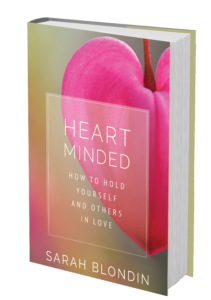
My new book, Heart Minded: How to Hold Yourself and Others in Love, was written to help remind us, reconnect us, reorient us with our hearts. Through story and guided meditation, I lead you through the fraught and sometimes frightening places holding you separate from your heart. It is a journey of healing that teaches you how to see and feel not from the mind, but from the wise seat of your very heart.

Now more than ever, we are being asked to move into the consciousness of the heart. Where love, compassion, “at-one-ment” become our governing virtues. When we see through the eyes of the heart, when we become heart minded, we stand as a beacon of light, burning back the dark.

Please join me in the heart-minded revolution. 

This originally appeared as an author letter to the Sounds True audience from Sarah Blondin.


sarah blondinSarah Blondin is an internationally beloved spiritual teacher. Her guided meditations on the app InsightTimer have received nearly 10 million plays. She hosts the popular podcast Live Awake, as well as the online course Coming Home to Yourself. Her work has been translated into many languages and is in use in prison, recovery, and wellness programs. For more, visit sarahblondin.com.


book cover

Learn More

Sounds True | Amazon | Barnes & Noble | Bookshop